About Zamioculcas zamiifolia (G.Lodd.) Engl.
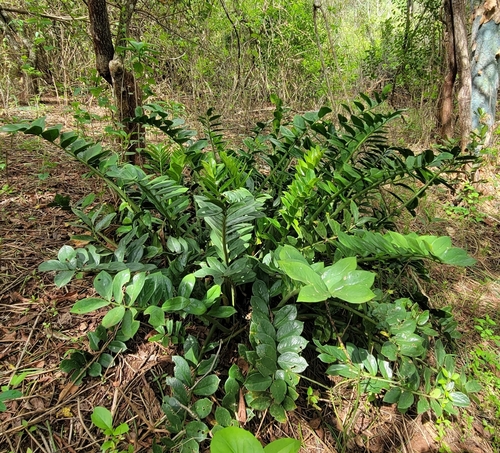
Zamioculcas zamiifolia (G.Lodd.) Engl. is a terrestrial, succulent, slowly growing, poisonous, evergreen, rhizomatous perennial herb. It produces erect, pinnately compound leaves 40 to 60 cm long, each holding 6 to 8 pairs of leaflets, with a thick petiole. It has a large, bulbous, fleshy potato-like rhizome. Its flowers form on a small 5–7 cm (2–3 in) long spadix that ranges in color from bright yellow to brown or bronze, and the spadix is wrapped in a yellow-green spathe. The entire inflorescence is partly hidden among leaf branch bases, and flowering occurs from midsummer to early autumn. This species is native to Kenya, KwaZulu-Natal in South Africa, Malawi, Mozambique, Tanzania, and Zimbabwe. It is a member of the family Araceae, a plant family known to contain cyanogenic glycosides, calcium oxalates, and possibly alkaloids. A toxicological experiment that used brine shrimp for a lethality assay found no evidence of lethality to the tested shrimp. It is cultivated as a houseplant; Dutch nurseries started wide-scale commercial propagation of this plant around 1996. Though little information is available about its traditional medicinal uses, Z. zamiifolia is reportedly used medicinally in the Mulanje District of Malawi and in the East Usambara mountains of Tanzania. In these regions, leaf juice is used to treat earache. In Tanzania, a poultice made from bruised Z. zamiifolia plant material is used to treat the inflammatory condition called "mshipa". Roots of Z. zamiifolia are used as a local topical application to treat ulceration by the Sukuma people of north-western Tanzania.