About Zamia loddigesii Miq.
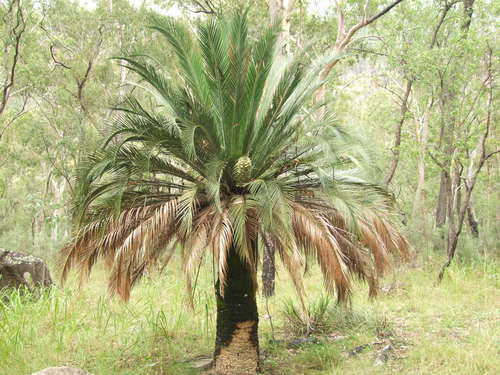
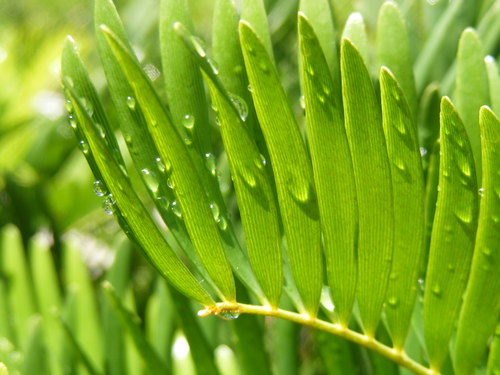
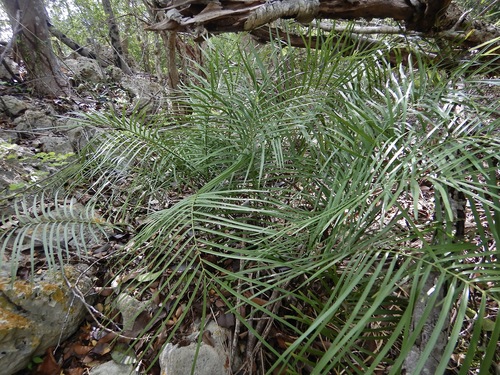
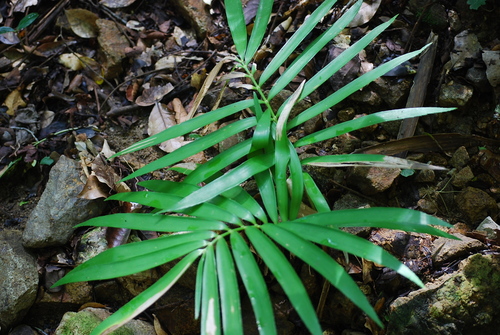
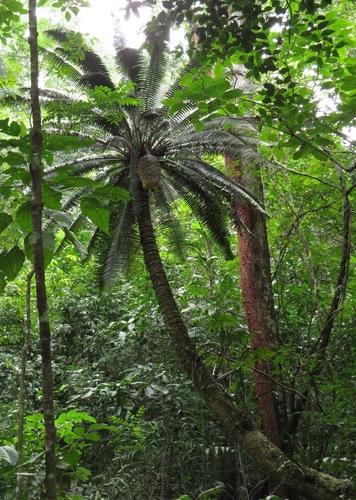
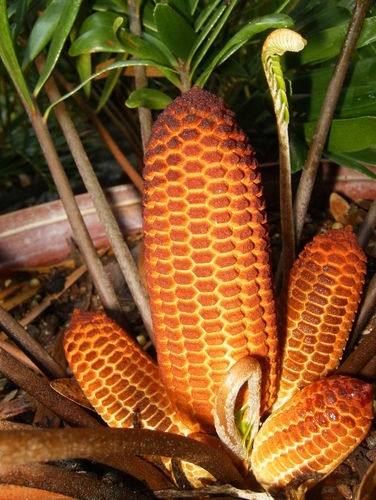
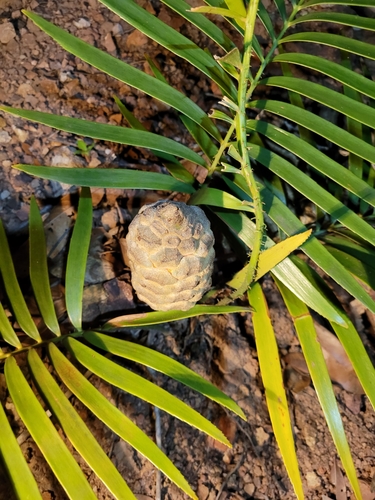
Zamia loddigesii Miq. has subterranean stems, and older stems develop branches. Mature stems measure 10 to 45 centimetres (3.9 to 17.7 in) in length, and 8 to 15 centimetres (3.1 to 5.9 in) in diameter. Each stem apex produces 2 to 3 compound leaves, which grow either upright or spreading. Leaves range from 45 to 96 centimetres (18 to 38 in) long and 30 to 41 centimetres (12 to 16 in) wide. Newly emerged leaves are light green, and deepen to green or dark green as they mature. The petiole (leaf stalk) is 15 to 25 centimetres (5.9 to 9.8 in) long, and bears prickles that grow up to 4 millimetres (0.16 in) long. The rachis (leaf midrib) reaches up to 57 centimetres (22 in) in length, and has a small number of prickles along its lower third. A single leaf holds 12 to 23 pairs of leaflets. Median leaflets measure 16 to 26 centimetres (6.3 to 10.2 in) long and 1.8 to 3.1 centimetres (0.71 to 1.22 in) wide. Like all cycads, Zamia loddigesii is dioecious: each individual plant is either male or female. A single stem apex produces one or two male strobili (male cones), and plants with multiple stem apices can grow up to six male cones total. Male cones are erect and cylindrical, measuring 8 to 14 centimetres (3.1 to 5.5 in) long and 1.8 to 3.5 centimetres (0.71 to 1.38 in) in diameter. They are light brown and covered in fine hairs. Their light brown peduncles (cone stalks) are also covered in hair, reaching 6 centimetres (2.4 in) long and 1.2 centimetres (0.47 in) in diameter. One or two female strobili grow on each plant crown. Female cones are erect, shaped from ellipsoid to conical, and grow up to 16 centimetres (6.3 in) tall and up to 6 centimetres (2.4 in) in diameter. These cones are beige and covered in hair. The female peduncle grows up to 6 centimetres (2.4 in) long and 1.6 centimetres (0.63 in) in diameter, and is brown and covered in hair. Seeds are ovoid, measuring 1.4 to 1.8 centimetres (0.55 to 0.71 in) long and 0.8 to 1 centimetre (0.31 to 0.39 in) in diameter. The sarcotesta (outer seed coat) is smooth, pink when immature, and turns red when the seed is fully mature. This species is native to the Mexican states of Hidalgo, Oaxaca, Tamaulipas, and Veracruz. Its populations are highly fragmented. Most of its native tropical dry forest habitat has been cleared for agriculture and cattle pasture, and remaining habitat is affected by frequent fires.