About Zamia integrifolia L.f.
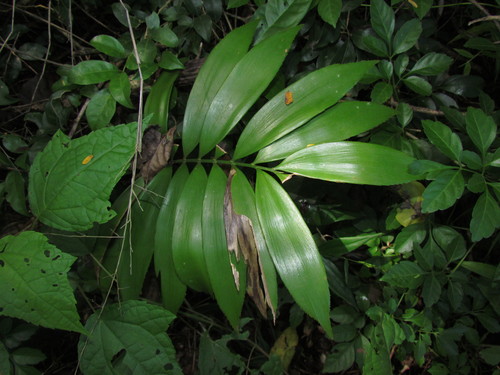
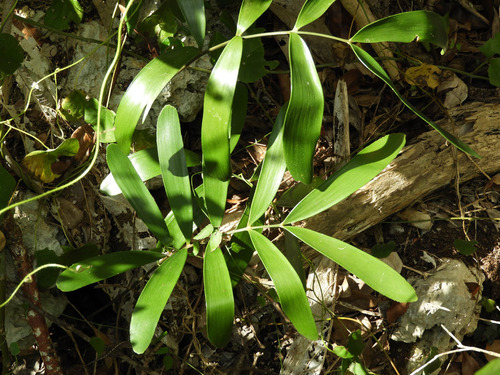
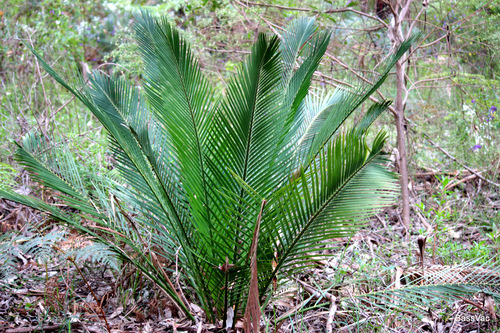
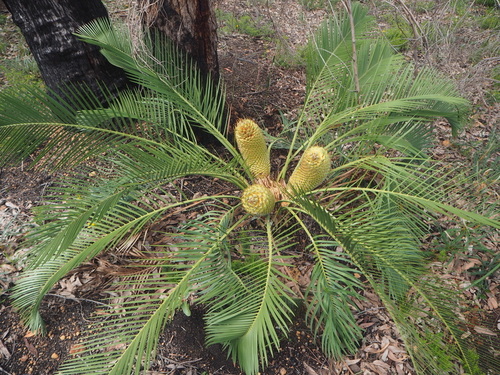
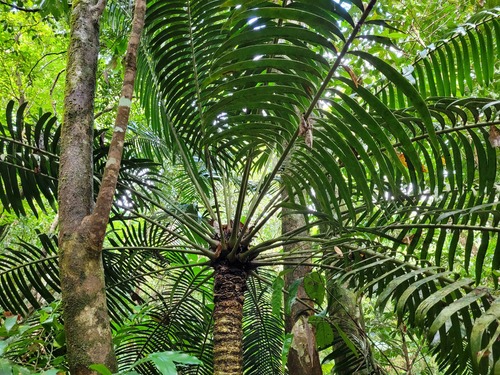
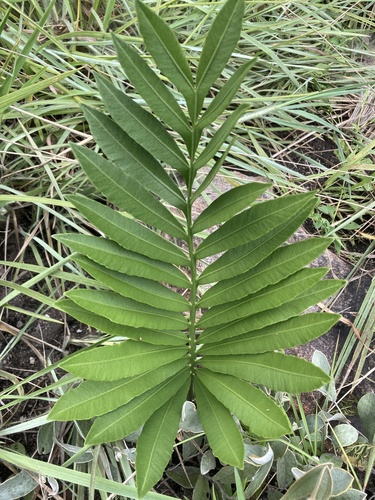
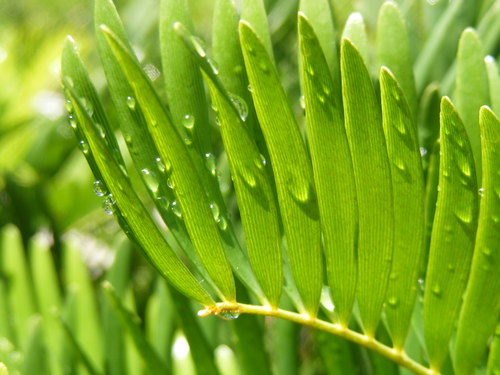
Zamia integrifolia L.f. is a low-growing cycad with a trunk that reaches 3 to 25 centimeters in height, and the trunk is often subterranean. Over time, it forms a multi-branched cluster along with a large, tuberous root system that is actually an extension of the above-ground stems. This cycad is relatively cold hardy, as it can drop all of its leaves and enter dormancy through its tuberous root system during cold periods. It can survive growing conditions in USDA hardiness zone 8b, where minimum temperatures range from 10°F to 20°F, and stems and leaves fully regenerate once cold ends. Like other cycads, Z. integrifolia is dioecious, meaning individual plants are either male or female. Male cones are cylindrical, 5 to 16 centimeters long, and often grow in clusters. Female cones are elongate-ovoid, reaching 5 to 19 centimeters long and 4 to 6 centimeters in diameter. The species produces reddish seed cones with a distinct acuminate tip. Its leaves are 20 to 100 centimeters long, with 5 to 30 pairs of leaflets (pinnae). Each leaflet ranges from linear to lanceolate or oblong-obovate, and measures 8 to 25 centimeters long and 0.5 to 2 centimeters broad. Leaflet margins are entire, or have indistinct teeth at the tip; leaflets are often revolute, and grow on prickly petioles. It is closely related and similar to Zamia pumila, but Z. pumila can be distinguished by more obvious toothing on its leaflets. Z. integrifolia grows in a range of habitats with well-drained sands or sandy loam soils, and prefers filtered sunlight to partial shade. In the United States, existing populations are limited to Florida. A Zamia now classified as Z. integrifolia (previously synonymized Z. umbrosa) was reported twice in extreme southeastern Georgia: once in 1928 from a single plant of uncertain origin, and once in 1971 from a single population of three plants on St. Simons Island, Glynn County. There have been no reports of Z. integrifolia in Georgia since 1971, and a 2016 search of Glynn County found no specimens, so the species is presumed extinct in Georgia. In the Bahamas, Z. integrifolia occurs in Bahamian pine forests and Bahamian dry forests: it is abundant on the Abaco Islands, common on northern Andros, rare on Grand Bahama, and found on New Providence only in the few remaining unfragmented patches of pine forest. It also grows in coastal thickets on Eleuthera and sandy coastal scrub on Tilloo Cay. In the late 19th century, Zamia plants in the Bahamas were called "bay rush" and were harvested on Andros and New Providence islands to produce starch. Z. integrifolia has also been reported from the north-central coast of Cuba, the Cayman Islands, and south-central Puerto Rico. Molecular phylogenetic studies published by Calonje et al. in 2019 and Lindstrom et al. in 2024 found that Florida Z. integrifolia is a sister taxon to all other Caribbean island Zamia species, while plants classified as Z. integrifolia from Cuba and the Bahamas have varying close relationships to Z. angustifolia and Z. lucayana. In ecology, the larvae of the Atala butterfly (Eumaeus atala) and several other Eumaeus species feed exclusively on cycad leaves, including those of Z. integrifolia. These larvae are gregarious, and all life stages are aposematic, with coloration that advertises their toxicity. Larvae ingest the carcinogen and neurotoxin cycasin from Z. integrifolia leaves and retain it into adulthood. Final instar larvae and adults hold 0.6 to 0.9 mg of cycasin, while bright yellow eggs contain 220 to 270 μg of cycasin. Mealybug destroyers (Cryptolaemus montrouzieri) are commonly found on Z. integrifolia, and the two species form a mutualistic relationship: the beetles protect the plant from pests in exchange for food, feeding on the coontie's natural enemies, scales and mealybugs, which reduces the need for pesticide use in cultivation. In reproduction, Zamia species often produce multiple cones near the stem tip or at the terminal of the caudex where it meets the above-ground stem. Z. integrifolia's cones (also called strobili) are borne on separate male and female plants due to the species' dioecy. Female cones are thick, have a velvety texture, bear red-orange seeds, and grow no longer than 6 inches. Male cones are narrow and tall, hold pollen, and can reach 7 inches in length. Female cones are usually borne singly, while male cones grow in groups or clusters. Z. integrifolia's growing season occurs in spring, and the plant's sex cannot be determined until it produces cones. Z. integrifolia is pollinated by the weevil Rhopalotria slossoni and the erotylid beetle Pharaxonotha floridana. P. floridana pollinates Z. integrifolia by using pollen-bearing male strobili as food for its larvae, which carry pollen as they move. The plant can regulate this mutualistic interaction by making seed-bearing female strobili poisonous to these larvae: the toxin beta-N-methylamino-L-alanine is present in pollen-bearing strobili but sequestered in idioblast cells that resist insect digestion, while the toxin is diffusely distributed in female cones. In contrast, R. slossoni does not consume pollen; instead, the weevils shelter in male cones, become coated in pollen, and carry pollen into female cones to achieve pollination. Although female cones are not consumed by the weevils, evidence of healed puncture scars has been found on the interior of female cones, which are suspected to be caused by R. slossoni. All parts of Z. integrifolia are very toxic except for the sarcotesta (the pulpy outer covering of the seeds). The plant contains the toxin cycasin, which can cause fatal liver failure, but cycasin is water-soluble and can be removed by leaching with water if proper precautions are taken. Z. integrifolia seeds also contain a toxic glycoside that causes headaches, vomiting, stomach pain, and diarrhea if ingested, as well as beta-methylamino-alanine, which can cause central nervous system failure.