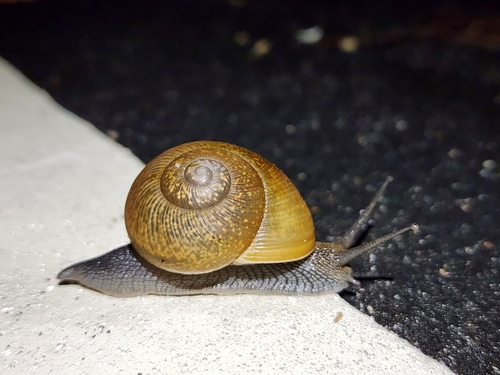
About Zachrysia provisoria (L.Pfeiffer, 1858)
Zachrysia provisoria (L. Pfeiffer, 1858) has a medium-sized shell, 25–30 mm wide, that is globose in shape with 4 to 5 whorls. Its spire is not very pointed. The apertural lip, the lip of the shell at the opening, is thick and slightly reflected, meaning it tilts upwards. The shell is generally very smooth, clean, and even shiny. Most shells are a rich dark tan and may have light brown streaks, while older shells can fade to yellowish brown. The mantle is speckled black, and it can be seen through the shell if the shell is translucent. A very closely related species is Zachrysia trinitaria (Pfeiffer); adult Z. trinitaria can be distinguished from Z. provisoria by their larger size, as they are 1.5 to 2.0 times bigger than Z. provisoria. This snail is native to Cuba. Along with other members of its subgenus, it is thought to occur in eastern and central Cuba, particularly in Granma Province. Its current distribution also includes Anguilla, Antigua, Bahamas, Barbados, Cayman Islands, Dominican Republic, Florida (with populations recorded in Brevard, Orange, Broward, Collier, Lee, Miami-Dade, Hillsborough, Monroe, Palm Beach and Pinellas counties), Guadeloupe, Jamaica, Mustique, Nevis, Puerto Rico, Saint-Bathelemy, Saint-Lucia, Saint-Martin/Sint Maarten, and the U.S. Virgin Islands. This species lives among leaf litter and ornamental plants. In its native range, it is usually found in shady ravines near leaf litter, in shrubby areas, and hiding around rocks. It prefers tropical climates, but can tolerate cool, dry winters. It can survive in forested areas and even mountainous regions as long as the environment has high moisture levels. Like other terrestrial snails, Z. provisoria may use love-darts during mating.

