About Yungipicus nanus (Vigors, 1832)
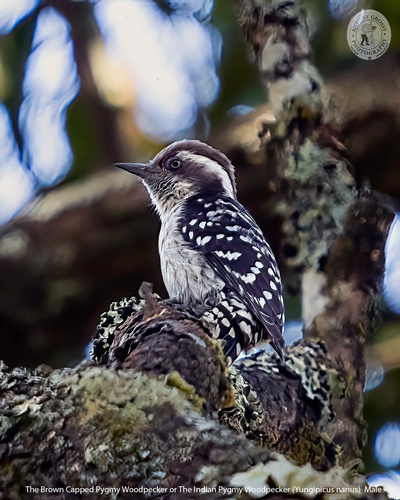
The brown-capped pygmy woodpecker (scientific name Yungipicus nanus (Vigors, 1832)) is a small brown and white woodpecker. It has a brownish cap that extends from the forehead to the hindneck, and distinctive pink-rimmed white irises. Its upperparts are barred brown and white, its underparts are lightly streaked dirty white, and its tail is spotted white. Its crown is paler brown, and it is edged red in males. It has eyestripes that contrast with white supercilia and cheeks.
This is a non-migratory bird found across most of India, except the northeast and the Thar desert, as well as in Nepal and Sri Lanka. It is generally resident, though birds living at higher altitudes may move to lower elevations during winter. It inhabits a diverse range of habitats up to 2300 m elevation, including deciduous forests, secondary forests, orchards, urban gardens, tropical and subtropical dry forests, tropical and subtropical moist forests, mangroves, and cultivated areas.
These birds are highly active, and often forage in pairs or mixed-species flocks in the tree canopy. They feed on small invertebrates by gleaning and probing wood, and also consume nectar and fruit. They are territorial and monogamous, and nest in tree cavities. Their call is a weak, rapid, rattling sound that rises in pitch, and lasts 1.2 to 1.5 seconds. Their breeding season runs from February to May. They excavate nesting holes 2 to 14 meters high in dead branches, with an entrance diameter of 3 cm. Both sexes take part in excavating the nest and feeding the young.