About Yungia aurantiaca (Delle Chiaje, 1822)
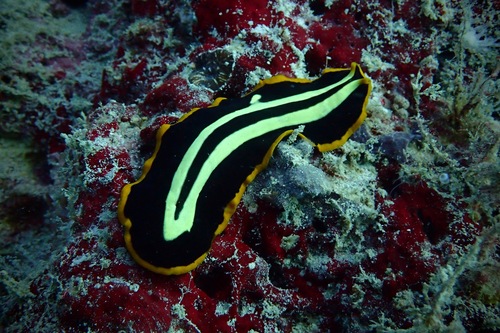
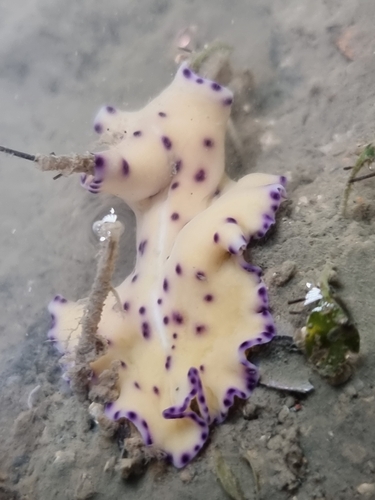
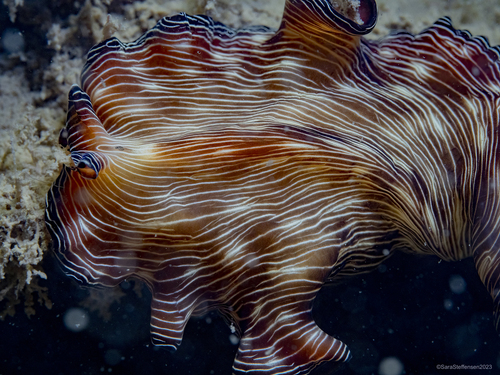
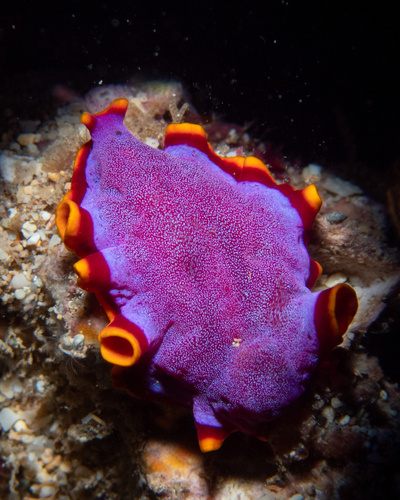
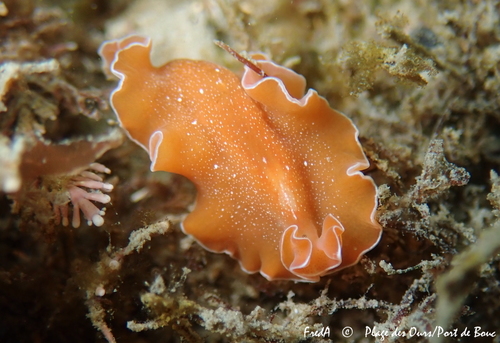
Yungia aurantiaca is a fairly large flatworm that reaches a length of about 40 mm (1.6 in). It is very thin and leaf-like, with a broadly oval outline, a thickened central ridge, and a lobed, wavy margin. Its dorsal surface is orange with fine white spots and a white margin, while its ventral surface is whitish. Folds at the edge of the head act as tentacles, with a horseshoe-shaped ring of eyespots located between these tentacles. The head also bears chemoreceptors. A single central opening on the underside functions as both the mouth and the anus, opening into the pharynx. This opening can act as a sucker to anchor the flatworm to a substrate. Yungia aurantiaca is a predatory species that feeds on tunicates, bryozoans, and other small sedentary invertebrates. To feed, it covers its prey with its body and secretes a sticky mucus that contains digestive enzymes. Food is ingested through the ventral mouth opening, and undigested waste is expelled through the same opening. Reproduction in this species is mainly sexual. All individuals are hermaphrodites, and fertilization occurs via traumatic insemination: when one flatworm successfully stabs another, it injects sperm that travels through the body to the oviducts, where eggs are fertilized. Yungia aurantiaca also has strong regenerative abilities; if its fragile body is torn into pieces, each section can grow into a new, fully functional individual. This flatworm can creep across surfaces using muscular contractions combined with the beating of cilia, and it is also capable of swimming. Swimming is accomplished by first bending the head and body sides downward, followed by body undulation, with waves of dorsal and ventral flexion starting at the head and traveling backwards along the body.