About Yucca L.
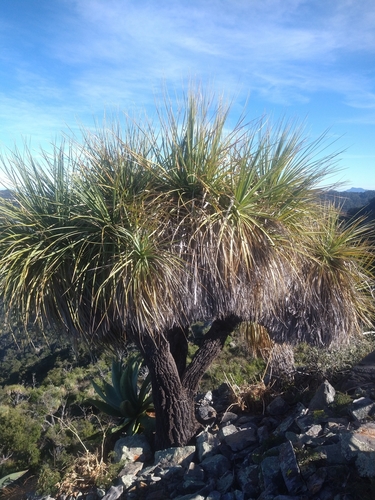
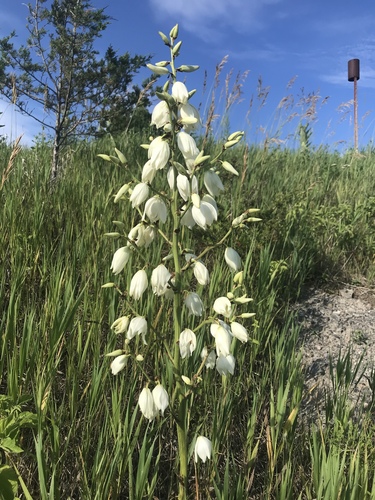
Yucca filamentosa is usually trunkless, and produces multiple suckers. It forms clusters of strappy, filamentous blue-green leaves that grow up to 75 centimetres (30 inches) long. This species is easily distinguished from other yuccas by the white, thready filaments that run along its leaf margins. In early summer, flower stems that can reach up to 3 metres (10 feet) tall produce large clusters of pendulous cream-colored flowers. Yucca filamentosa is native only to the region ranging from Maryland south to Florida and west to Louisiana; inland it is native to Tennessee and West Virginia, and has been introduced to Kentucky. It is also an introduced species in New York, Massachusetts, France, Germany, Italy, Albania, Hungary, Romania, and Turkey. In its native habitat, Yucca filamentosa most commonly grows in sunny open locations with sandy soil, especially in beach scrub and sand dunes, but it also grows in fields, barrens, and rocky slopes. It grows successfully in silt or clay soils as well. Typically, Yucca filamentosa spreads horizontally across open, sunny, dry areas, forming a dense thicket of sword-shaped foliage. It is hardy to USDA zones 5 to 12. Yucca filamentosa is pollinated by the yucca moth Tegeticula yuccasella. Other moth species, such as Tegeticula intermedia, also use this yucca as a host plant to lay their eggs. Yucca filamentosa is widely cultivated in mild temperate and subtropical climates. It is a fairly compact species, but still has a striking appearance from its sword-like leaves and dramatic flower heads. It naturally serves as a focal point in landscaping, and can add a tropical feel to temperate gardens. It requires full sun and well-drained soil, and prefers a pH between 5.5 and 7.5, which ranges from acidic to slightly alkaline. It develops a large, fleshy white taproot, along with deep lateral roots. Once planted and established, it is difficult to remove, because its roots continue to send up new shoots for many years. It is normally hardy down to −29 °C (−20 °F), which corresponds to USDA hardiness zones 5 to 9 and UK hardiness zone H7. After seeds are removed, the fruits of Yucca filamentosa can be cooked and eaten. The large flower petals can also be eaten raw in salads. The leaves, stems, and roots of this plant can be used to stun fish; the Cherokee people traditionally used the plant for this purpose.