About Yucca gloriosa L.
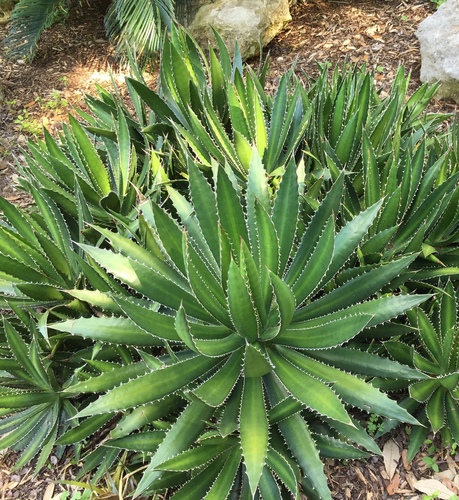
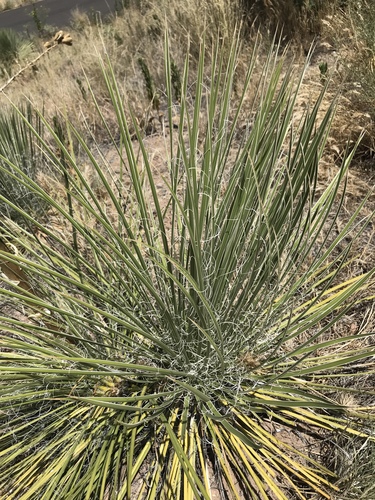
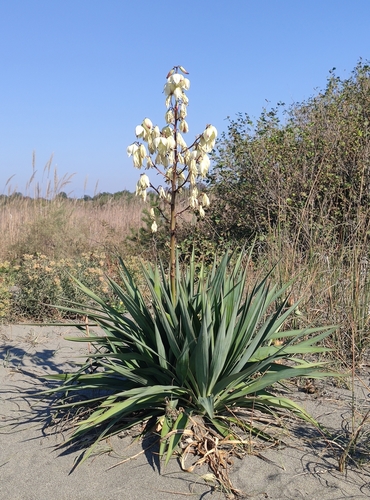
Yucca gloriosa L. is a caulescent species that typically produces several stems growing from its base; the base thickens in mature adult plants. Its long, narrow leaves are straight and very stiff, reaching 30–50 cm (12–20 in) in length and 2–3.5 cm (3⁄4–1+1⁄2 in) in width. The leaves are dark green, with smooth entire margins that are only rarely finely denticulate. They are acuminate, ending in a sharp brown terminal spine. Its inflorescence is a panicle that can grow up to 2.5 m (8 ft) long, holding bell-shaped white flowers that are sometimes tinged purple or red. Its fruit is a leathery, elongate berry that reaches up to 8 cm (3 in) long. In its native habitat, Yucca gloriosa grows on exposed sand dunes along the coast and barrier islands of the lower East Coast of the United States. It often grows alongside Yucca aloifolia and a variety formerly known as Yucca recurvifolia or Y. gloriosa var. recurvifolia, which is now classified as Y. gloriosa var. tristis. Large endemic populations of this species occur in the beach and dune environments of coastal North Carolina. Compared to Y. gloriosa var. tristis, the leaves of Y. gloriosa var. gloriosa are hard, stiff, erect, and narrower. Y. aloifolia differs from this species by having leaves with denticulate margins and a sharp-pointed terminal spine. Yucca gloriosa is native to the coast and barrier islands of southeastern North America, where it grows on sand dunes. Its native range in the United States extends from extreme southeastern Virginia south to northern Florida. It naturally grows in association with Yucca filamentosa, Yucca aloifolia, and Opuntia species. This plant is widely cultivated in warm temperate and subtropical climates, and is valued for use as an architectural focal point in landscaping. It has been reported to escape from cultivation and become naturalized in Italy, Turkey, Mauritius, Réunion, Guam, the Northern Mariana Islands, Puerto Rico, Argentina, Chile and Uruguay. For landscape use, it requires very little maintenance, only needing dead leaves removed as the shrub approaches its full mature height. The species is very hardy; it experiences no leaf damage at −20 °C (−4 °F), and can tolerate brief snow and freezing temperatures as well as long periods of drought. Yucca gloriosa, along with its cultivars 'Variegata' and Bright Star = 'Walbristar', has received the Royal Horticultural Society's Award of Garden Merit.