About Yucca elata (Engelm.) Engelm.
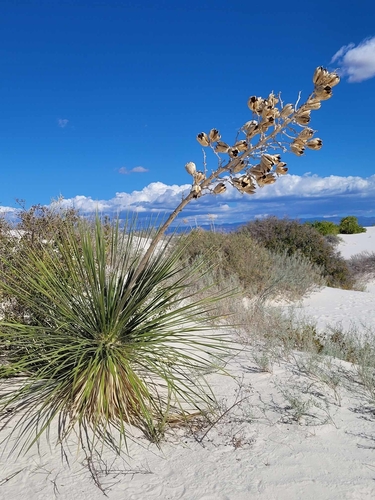
Yucca elata (Engelm.) Engelm., commonly called soaptree yucca, grows to a height between 1.2 and 4.5 meters, with a sparsely branched trunk. The trunk is brown, cylindrical, small in diameter, and often has holes left by exiting yucca moth larvae. Its leaves are arranged in a dense spiral whorl at the apex of stems; each leaf measures 25 to 95 cm long, very slender, and between 0.2 and 1.3 cm broad. White, bell-shaped flowers grow in a dense cluster on a slender stem at the stem apex. Each flower is 32–57 mm long, creamy white, and often tinged with pink or green tones. This species does not produce flowers every year. The fruit is a capsule 4–8 cm long and 2–4 cm broad. It matures to a brown color in summer, then splits into three sections to release its black seeds. Ecologically, soaptree yucca grows best in dry, semi-desert conditions. It is very cold-hardy, but requires full sunlight. Historically, Native Americans used fiber from the plant's leaves to make sandals, belts, cloth, baskets, cords, and mats, among other items, and also ate the plant's flowers. A soapy substance high in saponins is found inside the trunk and roots. In the past, this substance was commonly used as soap and shampoo to treat dandruff and hair loss. The Zuni tribe used a mixture of soap made from this yucca sap and ground aster to wash newborn babies to stimulate hair growth. The Apache people used yucca leaf fibers to make dental floss and rope. During drought periods, ranchers have used this plant as an emergency food source for cattle, as chopped trunks and leaves are edible for cattle.