About Yucca baccata Torr.
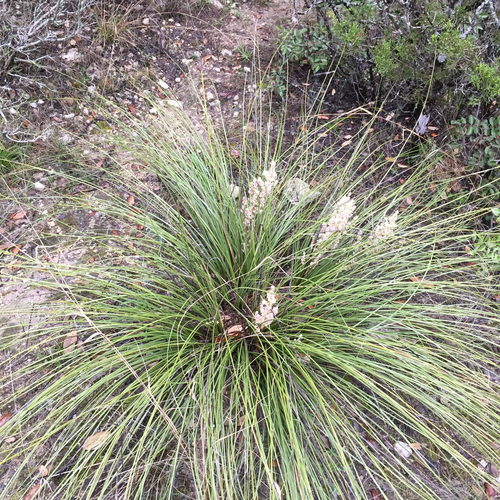
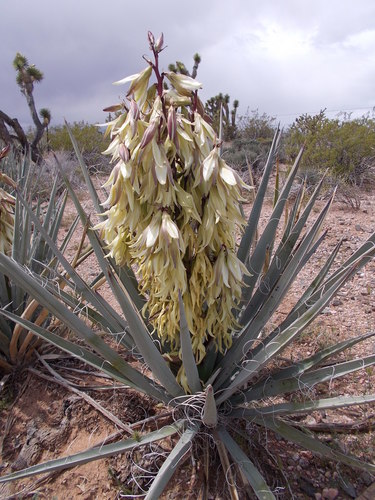
Yucca baccata Torr., also commonly called banana yucca, can be identified by its blue-green leaves that measure 50–76 cm (20–30 in) long, and its short or completely absent trunks. It flowers in spring, from April to July, with flowering timing varying based on location and altitude. Its individual flowers are 5 to 13 cm (2 to 5 in) long, have six segments, and are white to cream-colored with purple tinges. The plant's flower stalk is not particularly tall, typically reaching 1–1.5 m (3 1/2–5 ft) in height. The mature seeds are rough, black, and wingless, measuring 3–8 mm (1/8–3/8 in) long and wide, 1–2 mm (1/32–3/32 in) thick, and ripen 6–8 weeks after flowering. It produces indehiscent fleshy fruit that is 8–18 cm (3–7 in) long and 6 cm (2 1/2 in) across, cylindrical in shape, and has a flavor similar to sweet potato. Banana yucca is native to the southwestern United States and northern Mexico. Most of its native range falls within the United States, where it grows in Colorado, Utah, Nevada, California, Arizona, New Mexico, and Texas. In Mexico, it occurs in three states: Sonora, Chihuahua, and Coahuila. This species is found in the Great Basin, the Mojave, Sonoran, and Chihuahuan Deserts, the Arizona/New Mexico Mountains ecoregion, and the lower southern portions of the Rocky Mountains. It grows in multiple habitat types, including Pinyon-Juniper woodlands, desert grassland, Creosote bush scrub, sagebrush, and ponderosa pine stands, at elevations that are generally between 1,500 and 2,500 m (4,900 and 8,200 ft). It commonly grows alongside Yucca schidigera, Yucca brevifolia, Yucca arizonica, Yucca faxoniana, Agave utahensis, other Agave species, as well as cacti of the Sclerocactus, Pediocactus, Navajoa, and Toumeya genera. The species grows across a large area of North American deserts and shows considerable genetic and morphological variation across its range. Specimens from the higher mountainous regions of the Rocky Mountains are winter-hardy and can tolerate extreme environmental conditions. Ecologically, Yucca baccata acts as a larval host plant for the ursine giant skipper, yucca giant skipper, and multiple species of yucca moths, including Tegeticula baccatella. After finishing feeding on the plant, skipper larvae pupate within the yucca's roots. For human use, the young flower stalks of Yucca baccata can be cooked and eaten once the tough outer rind is removed. The fruit can be eaten either raw or cooked; cooked Yucca baccata fruit has a flavor similar to sweet potato. The Paiute people traditionally dried the fruit for storage and use through the winter. It remains a popular food source among Mexican Indian communities. Rural residents often eat the flowers of this species. Ancestral Puebloan peoples used fibers extracted from Yucca baccata leaves to make sandals and cordage, and used the plant's root to make soap, though they used this root soap less frequently than that made from Yucca elata.