About Yponomeuta padella Linnaeus, 1758
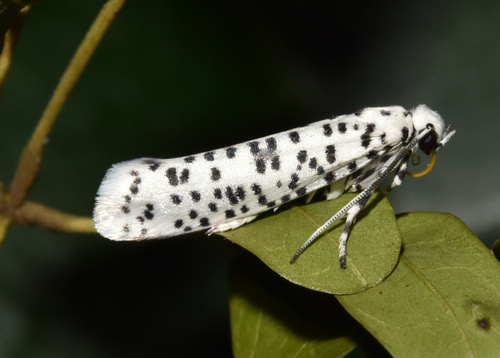
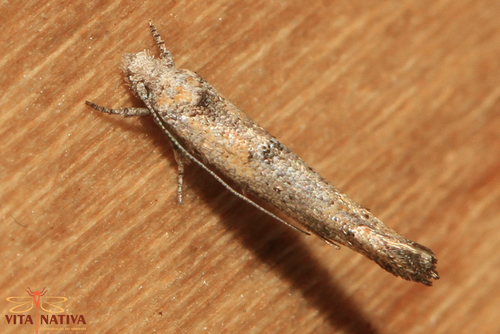
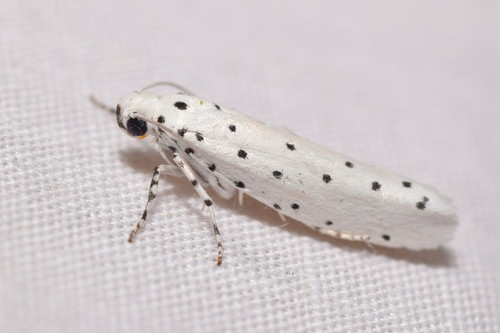
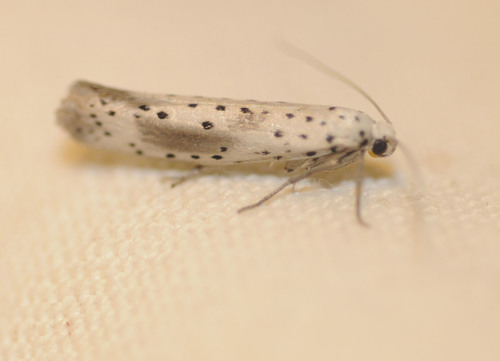
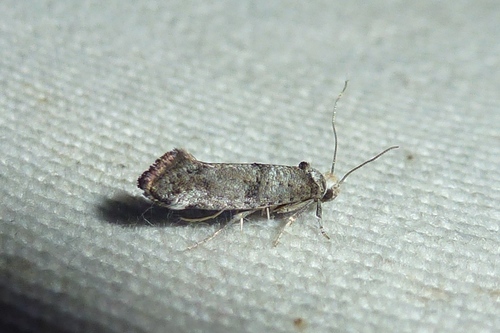
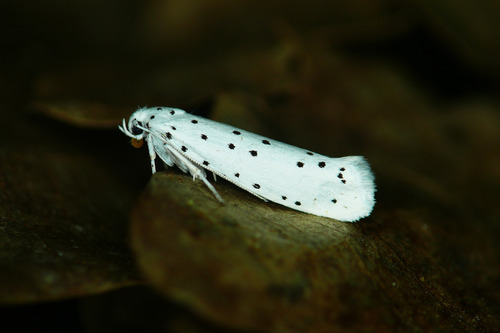
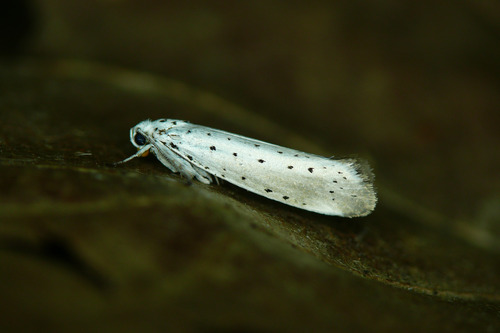
Yponomeuta padella (Linnaeus, 1758), commonly called orchard ermine or cherry ermine, is a lepidopteran species in the ermine moth family Yponomeutidae. This moth has a wingspan between 19 and 22 millimetres, which equals 3⁄4 to 7⁄8 of an inch. Adults have a white head. The forewings are light grey, and may sometimes be more or less suffused with white, especially toward the dorsum. Four longitudinal rows of scattered black dots mark the forewings: the first row does not reach the middle, the second row begins beyond the end of the first, and the lowest row contains 4 to 6 dots. Additional black dots appear before the termen, and the forewing cilia are light grey. The hindwings are a fairly dark grey. Fully grown larvae are greenish-grey with black spots and a black head. Yponomeuta padella is widespread across Europe, and occurs in any biome where its host food plants grow. In the territory of the former Soviet Union, it is widespread across the European part, reaching as far north as the Saint Petersburg area. To the east, its distribution extends to Transcaucasia, southern Kazakhstan, and central Asia. This species has been introduced to North America. In Northern Ireland, Y. padella was first recorded in 1972, when defoliation was observed in hedges of common hawthorn (Crataegus monogyna) and blackthorn (Prunus spinosa); no prior records of the species existed there, though Yponomeuta malinellus was already present locally. In parts of the Republic of Ireland, Y. padella populations reached epidemic levels within 30 years of its arrival. Over 10 years, the species colonized more than 600 square kilometres, or 230 square miles, and it continues to spread. Within this colonized area, populations occur randomly: most hedges remain uninfested, but populations persist for many years in infested locations. In North America, Y. padella was first discovered in British Columbia, and later found in Washington.