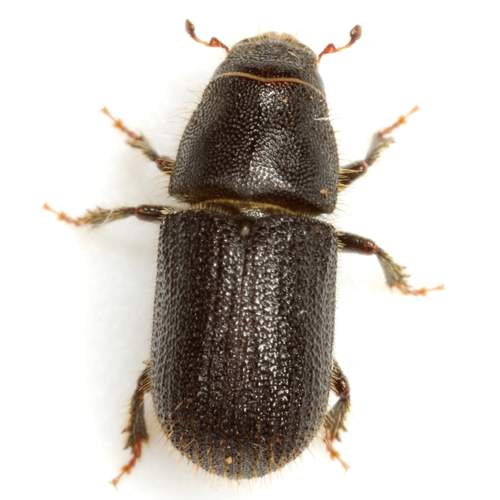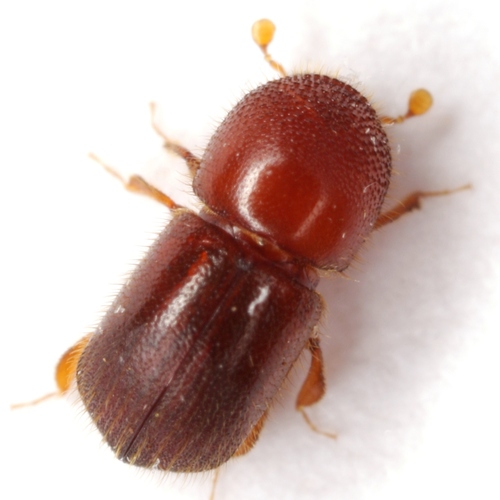
About Xylosandrus crassiusculus Wood, 1982
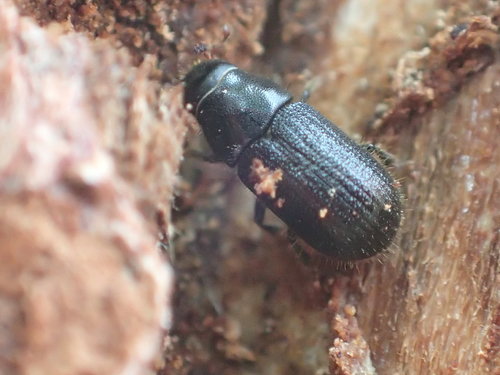
Xylosandrus crassiusculus, commonly called the Asian ambrosia beetle or granulate ambrosia beetle, is a species of tropical bark beetle in the family Curculionidae. It is native to Asia and has spread to become an invasive species in Africa, Europe, Australasia (Oceania), and the Americas. Adult beetles are reddish-brown and measure approximately 2 to 3 mm (0.08 to 0.12 inches) in length. The species was first reported in the southeastern United States in 1974. It reached Costa Rica by 1996, Panama by 2003, and Guatemala and northern Brazil by 2008. It was detected in Argentina in 2001, nearly a decade before it was found in southern Brazil and Uruguay. Because these two countries maintained vigilant long-term trapping programs, the 2001 Argentine detection may represent a direct introduction from a non-American source, with insects later spreading northward along the coast. For its life cycle, females mate with their siblings before exiting the natal galleries. Males are flightless, but females can fly to disperse to new potential host trees. Once at a new host, females excavate tunnels and lay eggs. Larvae develop and enlarge the galleries, while the female stays with the brood and overwinters inside the wood. Like other ambrosia beetles, even though larvae develop inside wood cavities, both adult and larval Xylosandrus crassiusculus feed exclusively on a symbiotic fungus that the female introduces into the excavated tunnels and galleries. For this species, the symbiotic fungus has been identified as Ambrosiella roeperi. The beetle is attracted to the smell of this fungus, which may lead to concentrated attacks on specific trees. This beetle can infest branches as small as 1.5 cm (0.6 in) across, and trunks between 2.5 and 6 cm (1.0 to 2.4 in) in diameter. It is a polyphagous species that infests many different species of host trees. It usually only attacks stressed young trees and nursery stock, but will sometimes attack apparently healthy young trees. It also infests stacked timber, where it causes economic damage. In the United States, recorded infested hosts include oak, cherry, crape myrtle, pecan, peach, plum, persimmon, elm, sweet gum, magnolia, fig, buckeye, and sweet potato. In Europe, its recorded host is the carob (Ceratonia siliqua). In Israel, where carob grows, the only known recorded host is the Palestine oak (Quercus calliprinos). In India, the beetle infests plantation crops including areca, coconut, and rubber; fruit plants including rambutan, cocoa, and jackfruit; and the timber tree teak.