About Xylophanes tyndarus Boisduval
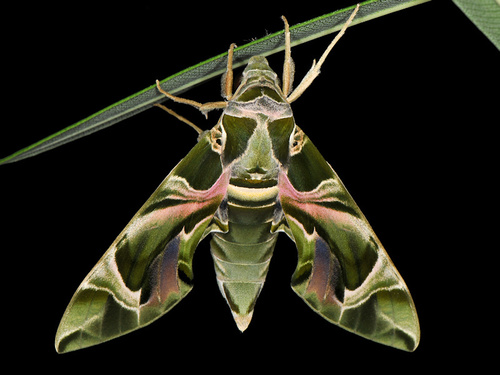
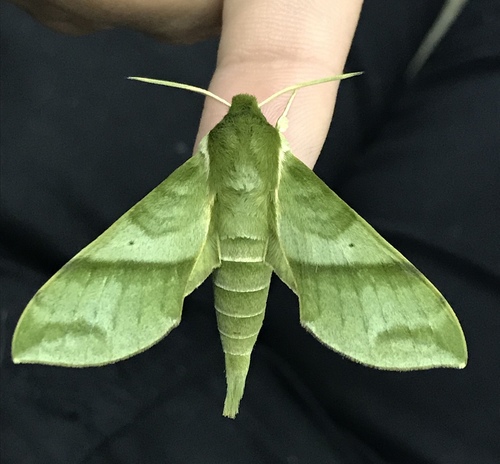
Xylophanes tyndarus is a moth belonging to the family Sphingidae, first described by Jean Baptiste Boisduval in 1875. Its distribution stretches from Mexico and Belize south to Brazil, extending west into Bolivia. This moth has a wingspan measuring 75 to 86 mm, which equals 3.0 to 3.4 inches. The upperside of both its body and wings is green, often a very bright shade. The underside of its body is whitish green. Each forewing has three narrow antemedian lines. The postmedian line on the forewing is well-marked and straight, with a sharply delineated basal edge and a diffuse distal edge that gradually lightens toward the outer margin. All other postmedian lines are poorly defined or completely absent. The oblique apical line on the forewing is short. On the underside of the forewing, this oblique apical line forms an angle with the irregularly undulate postmedian line; the marginal area bordered by these lines is the same width as it is in Xylophanes schausi. The green median band on the hindwing does not reach the costa. The hindwing's distal margin is often green. It is likely there are at least two generations of this moth per year. In Costa Rica, adults have been recorded from November to February, and again from April to July. In Brazil, adults have been recorded in September and December. The larvae feed on Faramea occidentalis, and probably feed on other Rubiaceae species as well. Early instars are green with yellow eyes, and feed only on new leaves. In the last instar, larvae turn brown and have a yellow eyespot.