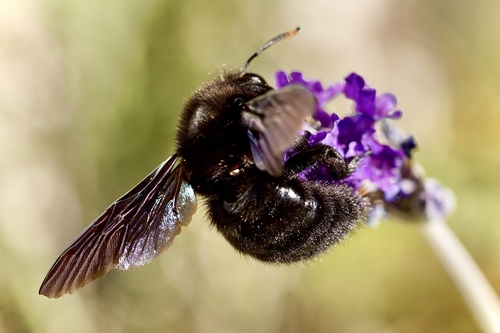
About Xylocopa violacea (Linnaeus, 1758)
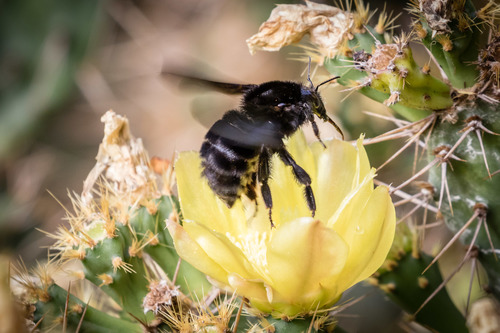
Xylocopa violacea, the violet carpenter bee, has a life cycle shaped by annual hibernation. Adult bees hibernate through winter inside abandoned wood nest tunnels, and emerge in spring, typically between April and May. In late spring or early summer, they can be seen searching for mates and appropriate nesting sites. After mating, fertilized females create new nests by boring tunnels into dead wood, which gives this group of bees the common name "carpenter bee"; they may also reuse older existing nest tunnels. Like other solitary bee species, the female builds and provisions her nest alone. She lays her eggs in a sequence of small individual cells, each stocked with a pollen ball to feed the developing larva. New adults emerge in late summer, then hibernate until the next year. The species' range extends from Europe east across Asia to central China, and it is only found at latitudes above 30 degrees. Xylocopa violacea was first reported from Cardigan, Wales in 2006, and was documented breeding for the first time in England's Leicestershire in 2007. This appearance in the British Isles follows a northward range expansion of the species through France, Germany, and the Channel Islands; by 2010, it had also been recorded in England's Northamptonshire and Worcestershire. In India, the common name "bhanvra" (called "bhomora" in Assamese) is used for any all-black Xylocopa species, so sightings of bhanvra are very commonly misattributed to Xylocopa violacea. Within India, Xylocopa violacea is only found in the northern regions of Jammu and Kashmir and Punjab. Most Indian sightings attributed to this species actually refer to other common black Xylocopa species, such as X. nasalis, X. tenuiscapa, or X. tranquebarorum.