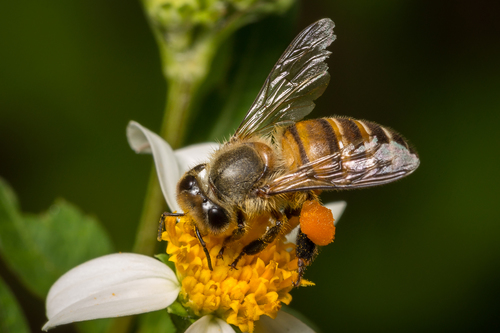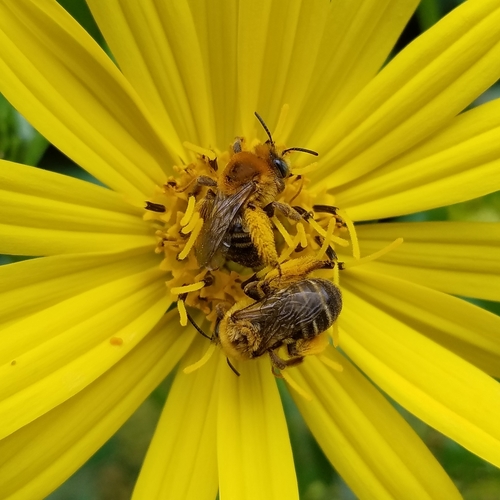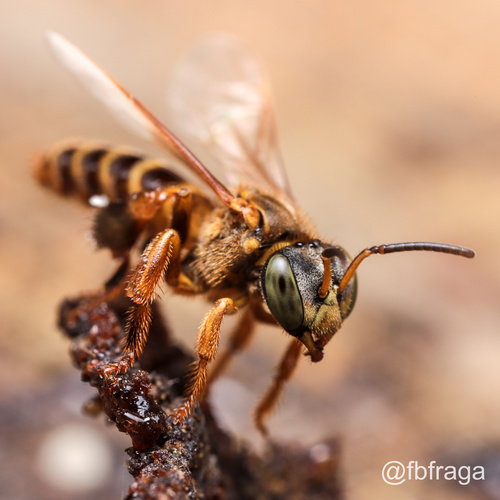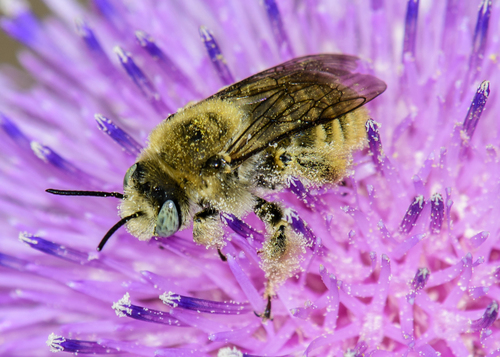
About Xylocopa sonorina Smith, 1874
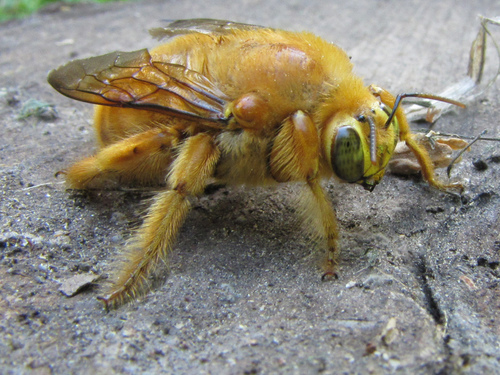
Description and identification: Xylocopa sonorina is among the largest bees found in California and Hawaii, reaching around 1 inch (2.5 cm) in length. Frederick Smith's original 1874 description of the female is as follows: Body is black; head and thorax are closely and moderately punctured; the mesothorax disk is smooth, impunctate, and shining; metathorax is rounded behind; abdomen is shining with relatively fine punctures, which are most closely spaced on the upper sides. All pubescence is black, except the pubescence on the underside of the anterior tarsi, which is ferruginous. Tarsal claws are ferruginous; wings are fusco-hyaline, with a darker cloud beyond the enclosed cells, and display bright purple and coppery iridescence. Like most native bees, female X. sonorina are not aggressive, and will normally sting only when provoked. Males lack stingers, but have a large thoracic gland that produces pheromones to attract females. Distribution and habitat: This species is primarily found in the southwestern United States (Arizona, California, New Mexico, Nevada, Texas, and Utah) and adjacent areas of Mexico. On the mainland, its primary habitats are valleys and foothills with deciduous forests dominated by oaks. X. sonorina is one of 11 non-native bee species established in the U.S. state of Hawaii. Human activity is thought to have helped the species colonize Pacific archipelagoes. It is unknown exactly when X. sonorina was introduced to the Hawaiian Islands, but the introduction occurred before 1874, when the species was originally named. Today, X. sonorina is found on all main Hawaiian Islands and the Mariana Islands. X. sonorina has been used as a pollinator of Passiflora edulis, a passion fruit species, in tropical agriculture. Hawaii is located more than 2,000 miles (3,219 km) from the nearest North American landfall, so its great distance from the Americas is considered too large for successful natural biological dispersal of X. sonorina, which supports the conclusion that human activity likely aided the bee's arrival in Hawaii. After colonizing Hawaii, X. sonorina was introduced to the Marianas Islands, China, and Japan, but none of these introductions were successful. The species has also been anecdotally reported from Midway Atoll, Java, New Guinea, and the Philippines. Only the report from Midway Atoll is confirmed by preserved voucher specimens. Out of more than 150 identified Xylocopa species native to North and South America (70 of which are found in Brazil alone), only two other species in the genus have successfully colonized Pacific archipelagoes east of the Americas, either through natural dispersal or human assistance. The first is Xylocopa darwini, which lives in the Galápagos Islands, 604 miles (972 km) west of South America, with mainland Ecuador as its closest landmass. The second is Xylocopa clarionensis, which occurs on Clarión Island in the Revillagigedo Islands, 700 miles (1,127 km) off the coast of Mexico. X. clarionensis is thought to be the closest relative of Xylocopa sonorina. Life cycle: In spring, females mate with males. After mating, females may disperse to start new nests, or clean out and enlarge old tunnels used over winter, then add new brood cells. Each brood cell is provisioned with bee bread, a mixture of pollen and nectar that serves as food for developing larvae. A single egg is deposited on the pollen mass, and each cell is sealed off with a partition made of sawdust. Young adult male and female bees hibernate inside the tunnels over winter. Pollination: Flowers are the only source of food and water for these bees. X. sonorina follows a daily pattern of visiting specific plant species at certain times, and females collect pollen to feed their brood. To collect pollen from most flowers, females gather pollen onto their hindlegs through contact with exposed anthers. For flowers with closed anthers, such as those in the Solanaceae family, they use buzz pollination: vibration of the bee's indirect flight muscles releases pollen from the anthers. X. sonorina foraging behavior involves quick movement between flowers. A 1996 study using Asystasia gangetica (Chinese violet) found X. sonorina visited 16 flowers per minute, spending an average of 1.5 seconds at each flower. It usually flies toward flowers from the front, lands on the petals, and moves to the bottom of the corolla. Another study found X. sonorina acts as both a primary and secondary nectar robber of A. gangetica, because it takes nectar through pre-existing or self-made perforations without contacting the flower's stigma during foraging. Floral nectar robbery occurs when carpenter bees create perforations near the base of a flower's tubular corolla to access nectar, and do not pollinate the flower in return. This behavior usually takes place when the flower is so deep the bee cannot reach the nectar with its tongue. Some flowers have evolved adaptive structures to protect against nectar robbery, such as thick strong corolla walls, or production of extrafloral nectar that attracts ants which deter bees from robbing nectar. However, ant defenses are only effective against certain bee species, and do not work against Xylocopa. X. sonorina has been used as a pollinator of Passiflora edulis, a passion fruit species, in tropical agriculture in Hawaii and Niue Island. Although valued for their pollination service, carpenter bee nesting behavior often leads to them being classified as pests, because they prefer to burrow into wood to create their nest galleries. To address this problem, the blister beetle Cissites auriculata was brought to Hawaii in 1934 in an attempt to reduce X. sonorina populations. There is no evidence that C. auriculata became established in Hawaii.