About Xylocopa aeratus (Smith, 1851)
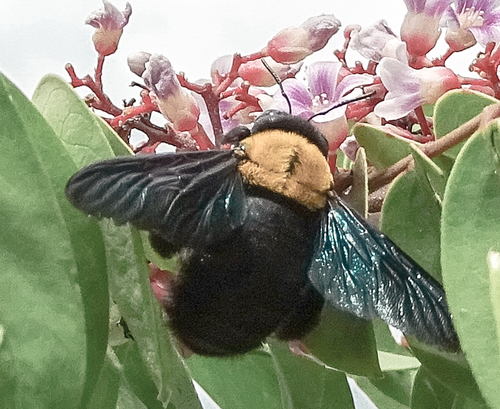
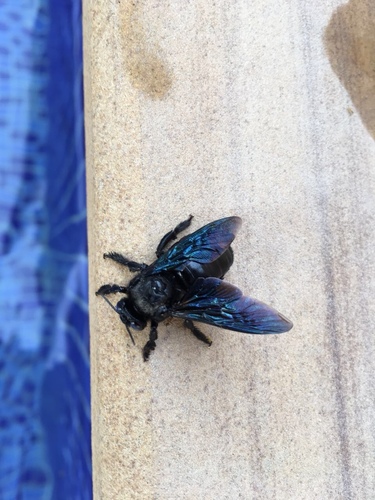
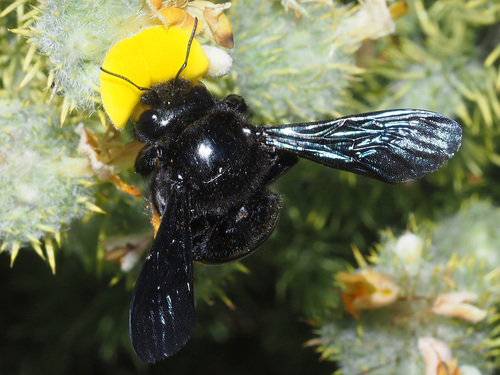
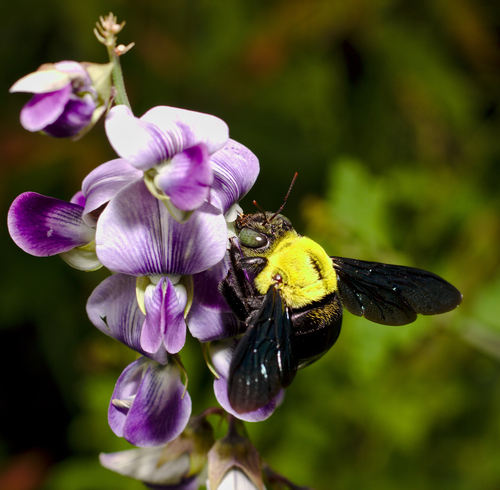
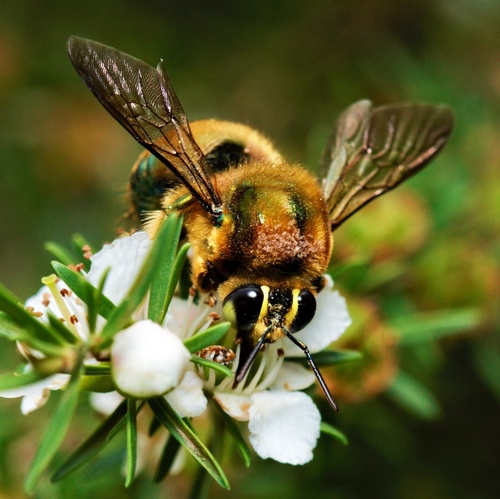
This species was originally described by F. Smith in 1851 under the synonym Lestis aeratus, with the current scientific name Xylocopa aeratus (Smith, 1851). Its specific epithet aeratus is a Latin adjective meaning "bronzed". Commonly called the golden-green carpenter bee, it has a metallic green body colour that can look purplish or bluish when viewed from certain angles. This is a large, stocky bee that reaches nearly 2 centimetres (0.79 inches) in length, making it one of the largest native bees found in southern Australia. It can often be detected by its loud, low-pitched buzzing as it flies between flowers. Males of this species have yellow markings on their faces. Xylocopa aeratus possesses a potentially painful sting, though no stings from this bee have ever been recorded. Its natural range covers southeastern New South Wales from Sydney southwards, where its distribution overlaps with that of Xylocopa bombylans, extending into Victoria and southeastern South Australia. However, the green carpenter bee became extinct on mainland South Australia in 1906, and went extinct in Victoria in 1938. Apart from populations remaining in conservation areas around Sydney and within the Great Dividing Range, the species only survives on the western half of Kangaroo Island in South Australia. These bees are active from spring through autumn. They commonly feed on pea flowers from the family Fabaceae, including Gompholobium species (Gompholobium latifolium is visited in spring, and Pultenaea tuberculata is visited in autumn). They also visit flowers of Leucopogon and Leptospermum.