About Xylobolus subpileatus (Berk. & M.A.Curtis) Boidin
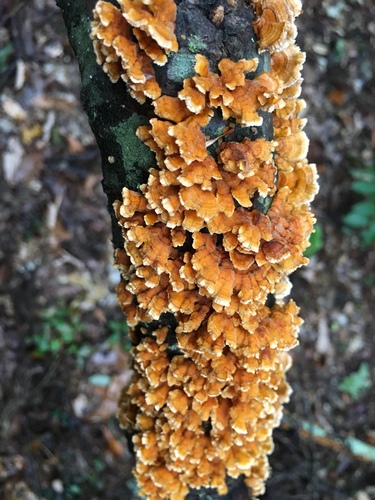
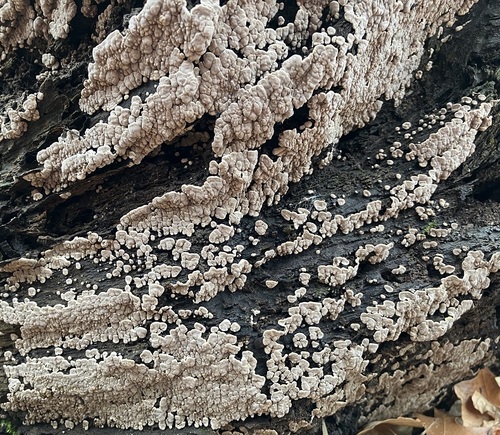
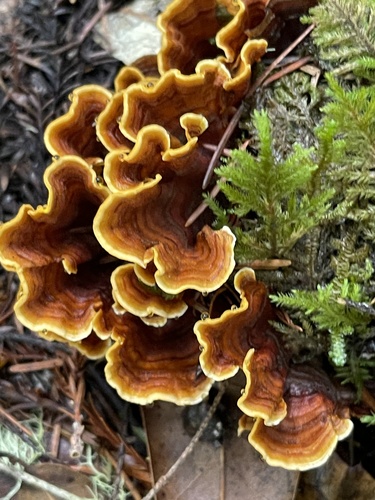
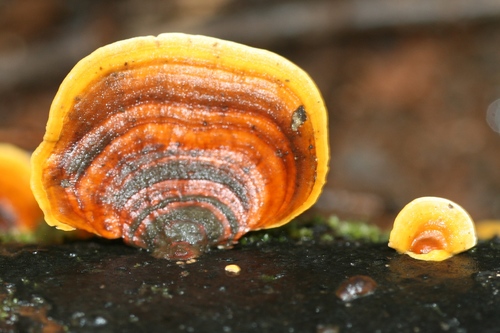
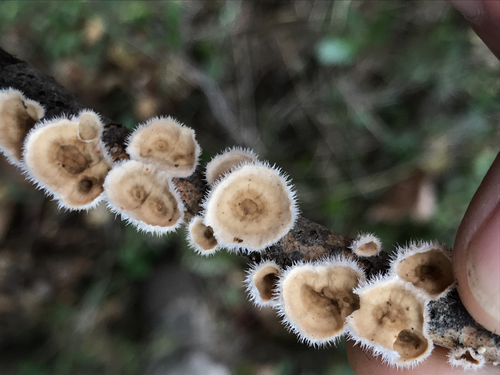
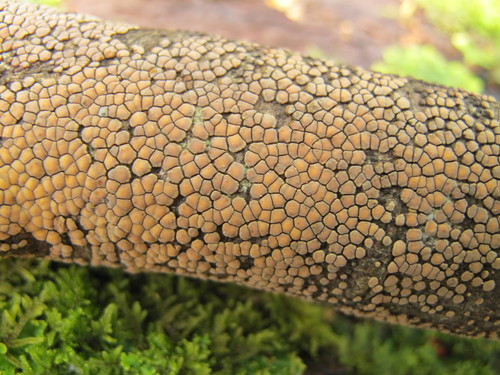
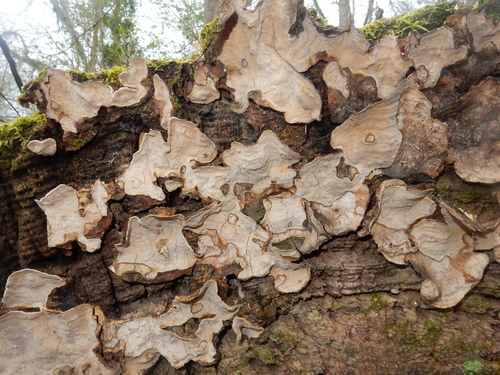
Xylobolus subpileatus has caps that are somewhat flat to wavy, with a dark zonate upper surface and a light underside. The caps range from 2 to 20 centimetres (1 to 8 inches) wide, and 1 to 3.5 cm (1⁄2 to 1+1⁄2 inches) deep. This wood-inhabiting species forms stereoid fruit bodies that are tough, crust-like basidiomes that adhere closely to their substrate. These structures typically develop as effused patches, or grow with reflexed margins on fallen oak logs. Basidiomes often grow next to a distinct honeycomb-like pattern of decay. This pattern forms when the fungus selectively degrades lignin, leaving medullary ray parenchyma and early-wood vessels intact between pockets of decayed wood. Xylobolus subpileatus is a saproxylic wood-decay fungus that colonises fallen oakwood, creating these characteristic honeycomb decay patterns through selective lignin degradation. Fruiting bodies only form on logs of Quercus species, and the probability of basidiome formation increases as the wood progresses through decay stages. For example, in old-growth oak forests of Corsica, fruiting probability rises steadily from around 7 years after treefall, reaching a peak at roughly 40 years, within natural canopy gaps that have deep shade and stable microclimates. Geographically, X. subpileatus has been recorded in at least 14 countries across North America, Europe, Asia, and South America, and is absent from Africa and Antarctica. In eastern North America, it is found in mature deciduous forests growing on fallen oak logs. In Europe, its populations are often scarce and highly localised, and several countries list the species as endangered (including Austria and Hungary) or critically endangered (the Czech Republic). In the Mediterranean basin, occurrences are limited to old-growth Quercus ilex stands on Corsica, where fruiting only occurs on logs in advanced stages of decay located within dated canopy gaps.