About Xylobolus frustulatus (Pers.) P.Karst.
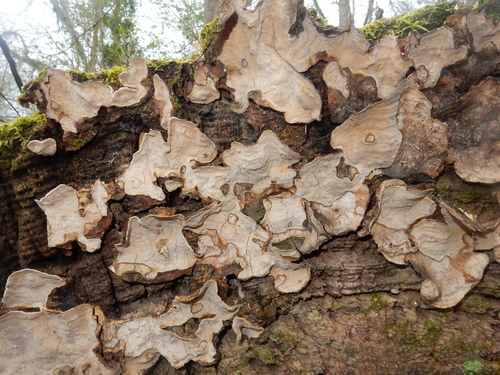
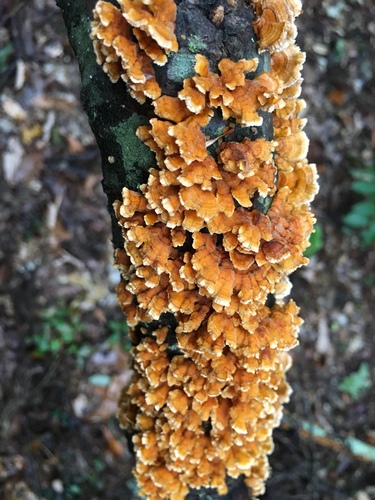
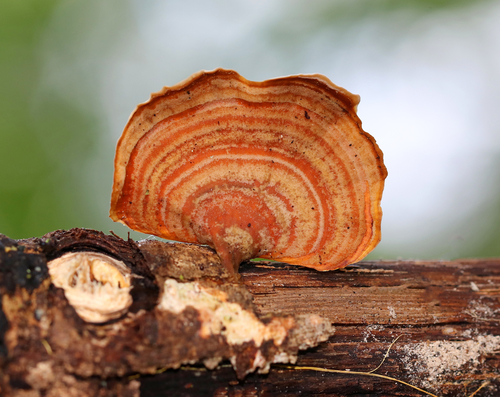
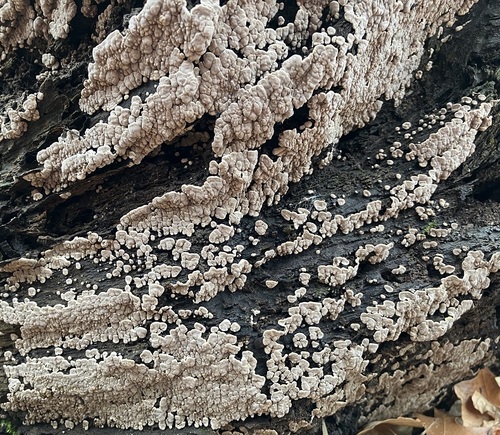
Xylobolus frustulatus (Pers.) P.Karst. produces a perennial, woody-textured fruit body (also called a crust). It is mostly 1–2 mm thick, though it can grow considerably thicker. It forms patches that measure 3–25 centimetres (1–10 in) across. The crust is frustose, meaning it cracks into small, angular polygons, and its edges curl infrequently. The upper surface is zonate, showing multiple zones of different color or texture, and is more or less smooth. To the naked eye, the hymenial surface is smooth, but microscopic examination reveals long soft hairs. These hairs are actually protruding acanthocystidia (cystidia that have a few projections near their tip) and hyphae. Young fruit body layers are pale ochraceous, while older layers dull to a deep brown. This fungus is inedible, and has no distinctive taste or odor. The hyphal system of Xylobolus frustulatus is monomitic, meaning only relatively undifferentiated generative hyphae that can develop reproductive structures are present. These vertically arranged, short-celled hyphae develop into acanthocystidia, have a diameter of about 3.5–5 μm, are sparsely branched, and are hyaline (translucent) to yellowish-brown. Hyphae in older layers may be more strongly pigmented. Other hyphae, such as those in the trama, are few or absent, and are most easily observed in very thin sections. These trama hyphae measure 3–5 μm wide, are vertically arranged, have thin to moderately thick walls, and develop into pseudocystidia. All hyphae of X. frustulatus lack clamp connections. Pseudocystidia, which are sterile structures that arise deep in the subhymenium and protrude into the hymenium, are rare. They have thin to moderately thick walls, and rarely project above the basidia and acanthocystidia. Acanthocystidia are numerous, and measure 25–30 μm long by 4–5 μm wide. The spore-bearing basidia are shaped like long clubs, are four-spored, and measure 25–30 by 4–5 μm. They are smooth or have a few basal protuberances (called acanthobasidia). The spores are short-ellipsoid in shape, have thin walls or slight wall thickening, are smooth, and typically measure 4.5–5 by 3–3.2 μm. They give a distinct amyloid reaction, and the spore print of this species is white. This fungus is saprobic, and only grows on well-rotted oak wood. It grows on branches and trunks lying on the ground, and is more rarely found on branches that remain attached to living trees. It is found in northern Europe, North America, and has also been recorded in Asia, including Japan and Taiwan. Classified as a white rot fungus, X. frustulatus is a selective degrader, meaning it breaks down lignin and hemicellulose faster than it breaks down cellulose. It is one of several known fungal species that break down timber used in coal mines. Sporulation generally occurs during the summer; most specimens collected in autumn and early spring are sterile, with a hymenium made up only of acanthocystidia. Xylobolus frustulatus may be parasitized by the Hypomyces mold Hypomyces xyloboli.