About Xylaria hypoxylon (L.) Grev.
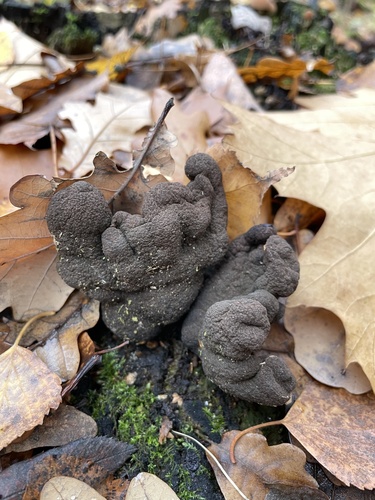
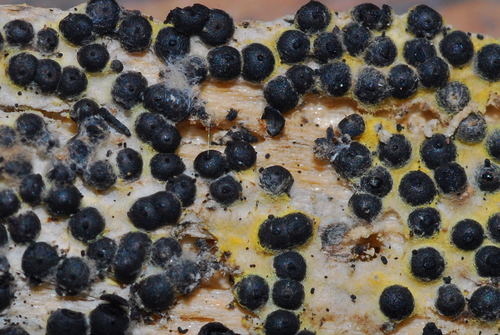
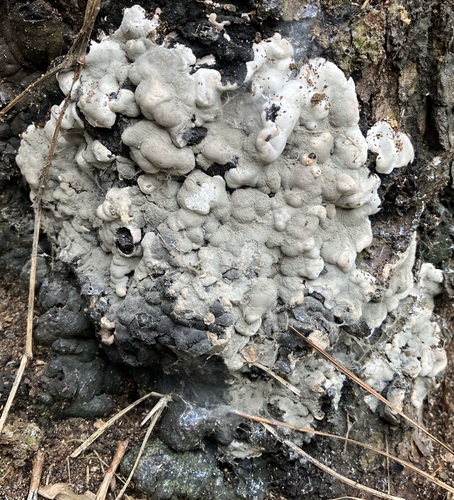
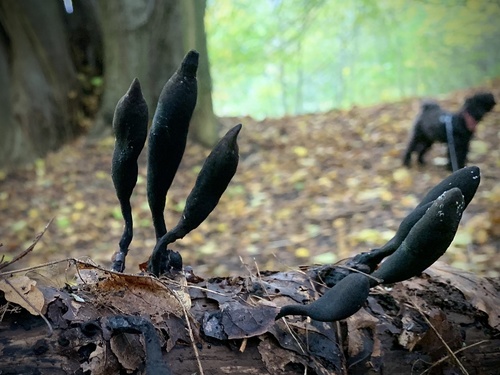
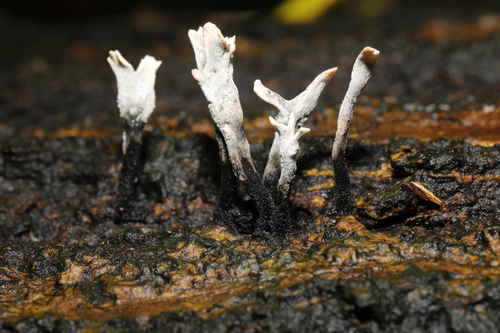
This fungus, formally named Xylaria hypoxylon (L.) Grev., produces upright fruit bodies called ascocarps that are cylindrical or flattened, measuring 3–8 cm tall and 2–8 mm thick. Ascocarps are commonly twisted or bent, usually sparsely branched, and often have a shape that resembles stag antlers. Early-season specimens collected in spring may be fully covered in asexual spores called conidia, which appear as a white to grayish powdery coating on the fruit body surface. Later in the season, mature ascocarps are charcoal-black, and their surfaces have small pimple-like bumps known as perithecia. These tiny, rounded structures produce spores, and each has a small opening called an ostiole that releases sexual spores known as ascospores. Perithecia are embedded inside the ascocarp's fleshy tissue, called the stroma, which is tough, elastic, and white. Inside each perithecium, asci measure 100 × 8 μm. Ascospores are kidney-shaped, black, and smooth, with dimensions of 10–14 × 4–6 μm. Asexual spores (also called mitospores) are ellipsoid, smooth, and hyaline. Fruit bodies typically grow in clusters on decaying hardwood. This fungus can cause root rot in hawthorn and gooseberry plants.