About Xolmis pyrope (Kittlitz, 1830)
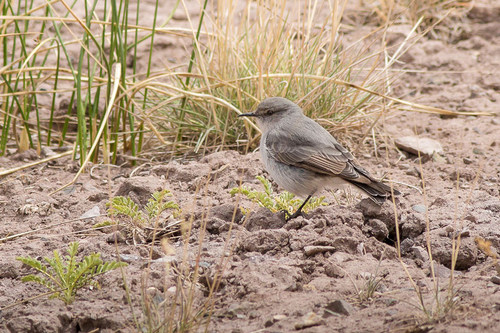
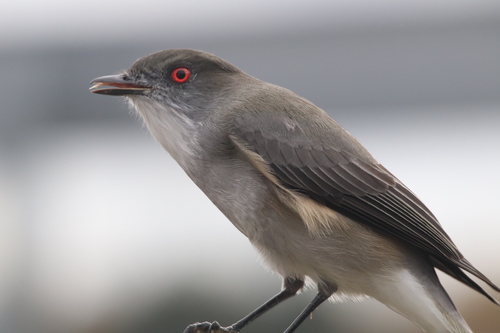
The fire-eyed diucon, scientific name Xolmis pyrope (Kittlitz, 1830), measures 18.5 to 21.5 cm (7.3 to 8.5 in) long and weighs 31 to 50 g (1.1 to 1.8 oz). Males and females have identical plumage. Adults of the nominate subspecies have dark gray crowns, faces, and upperparts. Their primary coverts and flight feathers are black, with pale gray edges on the inner flight feathers. Their tail is dark gray, with paler outer tail feathers and paler tips on all other tail feathers. Their throat is a very pale ashy gray with faint darker gray streaks. Their breast is a darker ashy gray, their belly is grayish white, and their vent area is white. Subspecies X. p. fortis is larger than the nominate subspecies, and has darker plumage on both its upperparts and underparts. Adult individuals of both sexes of both subspecies have a bright red iris, which is the feature that gives the species its common English name. All adults also have a black bill, and black or blackish legs and feet. Juvenile fire-eyed diucons have a brown iris. The nominate subspecies of the fire-eyed diucon ranges from the central Coquimbo Region of northern Chile and Neuquén Province in west-central Argentina south to Cape Horn. Subspecies X. p. fortis is found only on Chiloé Island, Chile. The nominate subspecies has additionally been recorded as a vagrant on the Falkland Islands. Across Chile and Argentina, the fire-eyed diucon inhabits open landscapes. These include the edge of Nothofagus forest, open woodlands, agricultural lands, gardens, and the shrubby ecotone between forest and steppe. In terms of elevation, the species mostly occurs up to at least 2,000 m (6,600 ft), and can be found as high as 3,050 m (10,000 ft).