About Xiphorhynchus triangularis (Lafresnaye, 1842)
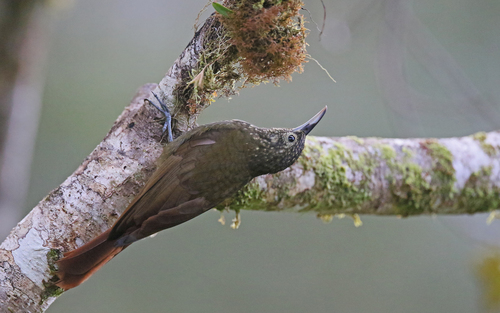
The olive-backed woodcreeper, with the scientific name Xiphorhynchus triangularis (Lafresnaye, 1842), measures 19.5 to 25 cm (7.7 to 9.8 in) long. Males weigh 40 to 52 g (1.4 to 1.8 oz), while females weigh 32 to 48 g (1.1 to 1.7 oz). It is a medium-sized member of the genus Xiphorhynchus, with a slightly decurved bill. The two sexes have identical plumage.
Adults of the nominate subspecies X. t. triangularis have a finely streaked face, with a buffy supercilium and eyering. Their crown and nape are blackish brown, marked with pale buff elongated spots. Their back, wing coverts, and rump are bright olive to brownish olive; the upper back has scattered buff streaks. Their uppertail coverts are cinnamon to rufous-chestnut. Their flight feathers have cinnamon to rufous-chestnut inner webs and bright olive outer webs, with dusky tips on the primaries. Their tail is dark rufous-chestnut. Their throat is buffy white with a blackish brown scaly pattern. Their underparts are a slightly lighter olive than their upperparts. Their breast has many buffy whitish spots, which become more triangular in shape on the belly. Their flanks are plain, their undertail coverts have thin streaks, and their underwing coverts are ochraceous. Their iris is dark brown; their maxilla is horn-black with a whitish to bluish ivory color on the side; their mandible is gray with paler spots on the side; and their legs and feet are blue-gray to gray with a faint olive cast. Juveniles are similar to adults, but are overall duller and have smaller spots on the breast.
Subspecies X. t. hylodromus has brighter olive brown upperparts than the nominate subspecies; its secondaries are darker and less reddish, its throat is paler with thinner scaling, and its underparts are lighter, more greenish olive, and more heavily spotted. Subspecies X. t. bangsi has more rufescent (less olive) upperparts than the nominate, with larger crown spots, more distinctly streaked back, a more whitish throat with olive rather than blackish scaling, smaller underpart spots that are replaced by narrow streaks on the belly, more rufescent undertail-coverts with finer streaks, and a whitish bill with black only on the base and tip of the maxilla. X. t. intermedius is intermediate between the nominate subspecies and bangsi, with slightly browner upperparts and paler, browner underparts than the nominate.
Of the olive-backed woodcreeper's subspecies, X. t. hylodromus is the northernmost, found in the coastal and interior mountains of northern Venezuela. The nominate X. t. triangularis ranges from the Andes of western Venezuela south through all three Andean ranges of Colombia and eastern Ecuador into northern Peru, reaching as far south as the Marañón River. X. t. intermedius is found on the eastern slope of the Andes in Peru's departments of Pasco, Junín, and Cuzco. X. t. bangsi occurs on the eastern slope of the Andes from southeastern Peru into central Bolivia.
The olive-backed woodcreeper inhabits middle elevations of the Andes. It is most common in humid evergreen montane forest and very humid cloudforest, and also extends into elfin forest. It prefers the interior of mature primary forest, but sometimes occurs at forest edges and in mature secondary forest. Most of its population ranges between 1,000 and 2,400 m (3,300 and 7,900 ft) in elevation, but it reaches as high as 2,700 m (8,900 ft) in Colombia and Peru, and occurs as low as 400 m (1,300 ft) in Colombia and Bolivia.