About Xiphorhynchus susurrans (Jardine, 1847)
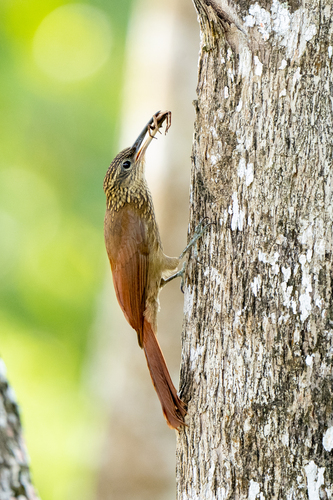
The cocoa woodcreeper (Xiphorhynchus susurrans) measures 21 to 25.5 cm (8.3 to 10 in) in length and weighs 43 to 58 g (1.5 to 2.0 oz). It is a medium-sized member of the genus Xiphorhynchus, with a long, fairly heavy, slightly decurved bill. The sexes have identical plumage. Adults of the nominate subspecies X. s. susurrans have a mostly dusky face marked with buff streaks and a whitish supercilium. Their crown and nape are dark brown to blackish with longish buff spots that become streakier on the neck and nape. Their upper back and wing coverts are olive-brown to brown, with blackish-edged buff streaks on the upper back that narrow and disappear on the lower back. Their lower back, rump, tail, and flight feathers are rufous-chestnut, with dusky tips on the primaries. Their throat is whitish to pale buff with thin black scaling. Their breast, sides, and belly are reddish brown that becomes redder on the undertail coverts. Their underparts are grayish olive to buffy brown; their upper breast has dusky-edged buffy white spots that become thin streaks on the lower breast and disappear on the belly. Their undertail coverts are mostly unstreaked, and their underwing coverts are cinnamon. Their iris is dark brown, their bill is mostly black (sometimes with brownish gray in the middle of the mandible), and their legs and feet are dark blue-gray, greenish gray, or yellowish gray. Juveniles are overall darker than adults, with a shorter and blacker bill, less prominent spots on the crown, and wider streaks on the underparts. Other subspecies of the cocoa woodcreeper differ from the nominate subspecies and one another as follows: in the "Cocoa" or "susurrans" group, which typically has spotted underparts, X. s. jardinei has a more rufescent back and deeper buff throat and underparts; X. s. margaritae has spots instead of a scaly pattern on the throat. In the "Lawrence's" or "nana" group, which typically has streaked underparts, X. s. nana has a deep buff throat and bold streaks rather than spots on the breast and belly; X. s. confinis has a more whitish throat and weaker but more extensive streaks than nana; X. s. costaricensis has a darker and deeper reddish back and rump, darker and more olive underparts, and reduced streaking compared to nana; X. s. marginatus has darker chestnut wings and tail, larger dusky tips on the primaries, a brighter buff throat, and blackish edges on crown and nape feathers; X. s. rosenbergi is much like nana but has wider and more boldly edged breast streaks. Different subspecies of the cocoa woodcreeper are distributed across the following ranges: X. s. confinis is found on the Caribbean slope of eastern Guatemala and northern Honduras; X. s. costaricensis occurs on the Caribbean and Pacific slopes from southeastern Honduras through Nicaragua and Costa Rica into western Panama; X. s. marginatus lives on the Pacific slope of central Panama; X. s. nana is found on the Caribbean and Pacific slopes of eastern Panama, across much of northern Colombia, and in northern and western Venezuela; X. s. rosenbergi inhabits the upper Cauca Valley in Colombia's Valle del Cauca Department; X. s. jardinei is located in northeastern Venezuela; X. s. margaritae occurs on Isla Margarita off the Venezuelan coast; X. s. susurrans is found on Trinidad and Tobago, with one mainland record in Venezuela. The cocoa woodcreeper mostly inhabits humid evergreen forest. It favors gallery forest, deciduous woodland, and the edges of primary forest and mature secondary forest. It occurs less frequently in the interior of primary forest, in young secondary forest, in plantations, and in open areas with scattered trees. It also lives in mangroves along some coasts, and on Isla Margarita it inhabits arid scrub. In terms of elevation, it is mostly found below 900 m (3,000 ft), but it reaches 1,000 m (3,300 ft) in northern Central America, 1,600 m (5,200 ft) in Colombia, and occasionally 2,400 m (7,900 ft) in Venezuela.