About Xiphorhynchus picus (Gmelin, 1788)
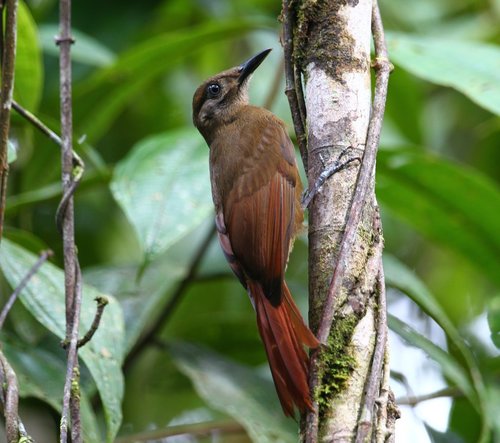
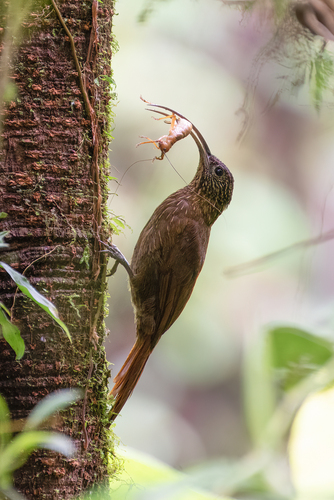
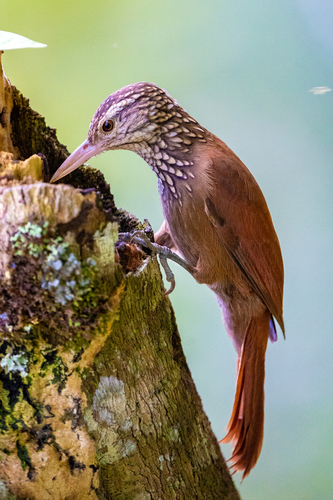
Xiphorhynchus picus, commonly known as the straight-billed woodcreeper, is 18 to 22 cm (7.1 to 8.7 in) long. Males weigh 34 to 42 g (1.2 to 1.5 oz), mainland females weigh 33 to 45 g (1.2 to 1.6 oz), and one female from Trinidad weighed 51 g (1.8 oz). It is a slim, medium-sized woodcreeper with a distinctive bill: the maxilla has a straight culmen, and the mandible curves upward. The sexes have identical plumage. For the nominate subspecies X. p. picus, adults have an indistinct pale supercilium and eyering, a dusky stripe behind the eye, and brown ear coverts marked with wide buffy white streaks. Their forehead is whitish, while their crown and nape are dark brown to blackish with buffy white streaks that grow larger on the nape. Their upper back, scapulars, and lesser wing coverts are warm olive-brown to reddish brown; the remaining wing coverts are more rufescent, and the upper back has a few thin pale streaks. The lower back, rump, flight feathers, and tail are rufous-chestnut. Flight feathers have dusky tips, and inner tail feathers are darker than outer tail feathers and the rump. The chin and throat are buffy white, with a dark brown to black scaly pattern that extends onto the upper breast. The rest of the underparts are brown, with some olive tone on the belly. The scaly pattern on the upper breast becomes more linear on the lower breast, sides, and flanks, and does not reach the belly. Undertail coverts have thin buffy-whitish streaks, and underwing coverts are cinnamon-rufous. The iris ranges from reddish brown to dark brown. The bill is light grayish horn or brownish to dull whitish; the base of the maxilla is dusky or blackish, and the mandible is often paler than the maxilla. Legs and feet are highly variable in color, ranging from green to gray to brownish. Juveniles resemble adults but are darker overall, with a deeper buff throat, smaller but more extensive deeper buff spots and streaks on the underparts, and a shorter, darker bill. Other subspecies differ from the nominate and each other as follows: D. p. picirostris has paler but more rufous upperparts than the nominate, bolder markings, whitish crown and back spots with black borders, whitish ear coverts and supercilium, and an almost white throat and upper breast; D. p. extimus is similar to picirostris but more brownish than rufous; D. p. dugandi has more extensive black surrounding crown and back spots than picirostris, and is darker than picirostris and paler than extimus; D. p. saturatior is much darker than the nominate and has less breast streaking; D. p. choicus is similar to dugandi but lighter overall, with weaker dark surrounds on crown and back spots; D. p. longirostris is similar to picirostris but larger, with a longer, heavier bill, wider breast spots, a darker less rufescent belly, and deeper chestnut back, wings, and tail; D. p. paraguanae has a longer bill, whiter throat, and lighter more yellowish-tinged upperparts than most other subspecies, and lighter brown underparts than longirostris; D. p. altirostris has a longer, heavier, more curved bill than the nominate, and larger, more extensive spots on the underparts; D. p. phalarus resembles longirostris but has larger crown and nape spots and buffier breast spots; D. p. duidae has a pure white throat, browner back, more black-outlined spotting on the breast, and stronger streaks on the belly; D. p. deltanus is darker than duidae, with a darker bill, darker crown, darker tail, and more heavily streaked upper back than the nominate; D. p. peruvianus is brighter and more rufescent than the nominate, with a deeper buff throat. Straight-billed woodcreeper subspecies are distributed across the following ranges: D. p. extimus is found in central and eastern Panama (mostly on the Pacific slope) and Córdoba Department in northwestern Colombia; D. p. dugandi occurs in inland northwestern Colombia from the Santa Marta area east to the Serranía del Perijá, south along the Pacific coast to northern Chocó Department, and in the Magdalena River valley; D. p. picirostris ranges along coastal northern Colombia from the Santa Marta area into extreme northwestern Venezuela, reaching Lake Maracaibo; D. p. saturatior is found on the eastern side of Colombia's Eastern Andes and in the Andes of western Venezuela; D. p. choicus occurs along coastal north-central Venezuela from Falcón east to Miranda; D. p. paraguanae is found in Falcón and Lara states in northwestern Venezuela; D. p. longirostris is restricted to Margarita Island off northern Venezuela; D. p. altirostris occurs on Trinidad; D. p. phalarus is found in Venezuela's llanos and northeastern coast; D. p. deltanus occurs in Delta Amacuro state in northeastern Venezuela; D. p. picus ranges across southern Venezuela, the Guianas, and north, central, and eastern Brazil from the Negro River east to the Atlantic and south to Goiás and Rio de Janeiro states; D. p. duidae occurs in the upper reaches of the Orinoco and Negro rivers in eastern Colombia, southern Venezuela, and northwestern Brazil; D. p. peruvianus is found in the southwestern Amazon Basin of eastern Peru, northern and eastern Bolivia, and southwestern Brazil. Populations of straight-billed woodcreeper north of the Amazon River in northwestern Brazil, and in southwestern Brazil's Pantanal, southeastern Colombia, and eastern Ecuador may belong to either D. p. picus or D. p. peruvianus. The straight-billed woodcreeper inhabits a wide variety of lowland habitats, most of which are open to semi-open rather than densely forested. Habitats include dense forest edges, open woodland, wooded savanna, deciduous and gallery forest, seasonally flooded várzea and igapó forest, river islands, secondary forest, mangroves, thorn scrub, and plantations. In terms of elevation, it is mostly found below 600 m (2,000 ft), reaching only 300 m (980 ft) in Panama. It has been recorded up to around 700 m (2,300 ft) in Colombia, 1,100 m (3,600 ft) in Peru, and 1,400 m (4,600 ft) in Venezuela.