About Xiphorhynchus erythropygius (P.L.Sclater, 1860)
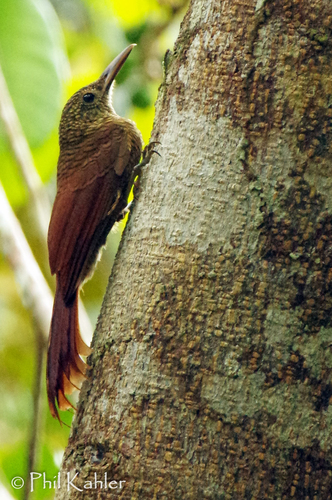
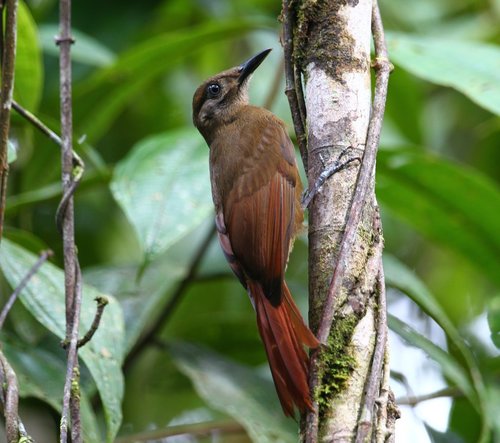
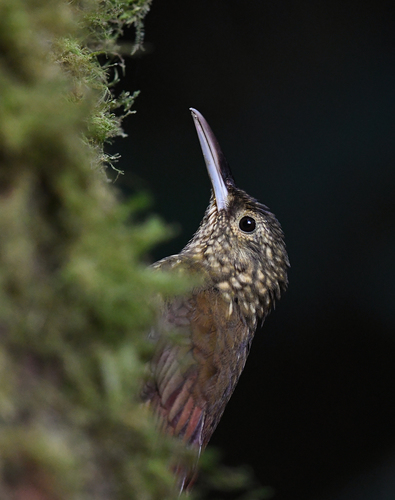
The spotted woodcreeper (scientific name Xiphorhynchus erythropygius (P.L.Sclater, 1860)) is 19 to 24 cm (7.5 to 9.4 in) long. Males weigh 40 to 54 g (1.4 to 1.9 oz) and females weigh 40 to 46 g (1.4 to 1.6 oz). It is a medium-sized member of the genus Xiphorhynchus, with a somewhat long, slightly decurved, and gradually tapering bill. The sexes have identical plumage. For the nominate subspecies X. e. erythropygius, adults have dusky lores, a buff supercilium and eyering, and dusky olive ear coverts marked with buff streaks. Their crown and nape are dark olive to brownish olive, with small buff spots and a narrow dusky edge. Their back and wing coverts are brownish olive to tawny brown, with buff spots and wide buff streaks. Their rump is dark cinnamon-rufous, and their flight feathers are rufous-chestnut, with olive-brown edges and dusky tips on the primaries. Their tail is rufous-chestnut. Their throat is buffy with narrow dark olive barring. Their underparts are pale greenish olive, with large buff teardrop-shaped markings that are paler on the flanks and undertail coverts. Their underwing coverts are deep buff. Their iris is dark brown. Their maxilla is blackish to dark brown, and sometimes has a pale stripe along its cutting edge. Their mandible is whitish horn to pinkish gray, and their legs and feet are blue- or greenish gray to slate gray. Juveniles are similar to adults, but are overall browner with less distinct spots on their underparts. Other subspecies differ from the nominate and each other as follows: X. e. parvus is smaller, with more rufescent upperparts. X. e. punctigula is smaller and more greenish overall, with fine streaks on the forehead, a plain crown and nape, fine streaks on the upper back and plain upperparts otherwise, and fewer and smaller spots on the underparts. X. e. insolitus resembles punctigula, but has slightly darker upperparts and lighter rufous wings. X. e. aequatorialis is smaller and more greenish overall, with a buffier eyering, fine streaks on the forehead, a plain crown and nape, sparse fine buff streaks on the upperparts, rufous rump, tail, and wings, spots (not scales) on the throat, and larger buff spots on the underparts. The subspecies of the spotted woodcreeper have discontinuous ranges distributed as follows: X. e. erythropygius occurs in central and southern Mexico, from San Luis Potosí and Hidalgo south to Oaxaca and Guerrero. X. e. parvus ranges from southern Oaxaca and Chiapas in Mexico through Guatemala, northwestern El Salvador, Honduras, and north-central Nicaragua, and is found locally in southern Belize. X. e. punctigula ranges from southeastern Nicaragua through Costa Rica into central Panama. X. e. insolitus occurs discontinuously from central Panama into northwestern and north-central Colombia. X. e. aequatorialis occurs on the Pacific slope from western Colombia to southwestern Ecuador. The spotted woodcreeper lives in humid forest. At lower elevations, it favors tropical evergreen forest. At higher elevations, it favors evergreen montane forest and cloudforest, and especially in the northern part of its range, pine and pine-oak woodlands. Across all landscapes, it favors forest with a heavy cover of moss and epiphytes. In mature forest, it usually stays in the canopy of the forest interior, but it is regularly found at forest edges, in older secondary forest, and sometimes in tree plantations and among scattered trees near continuous forest. In terms of elevation, it mostly occurs between 600 and 1,800 m (2,000 and 5,900 ft). It reaches as high as 2,900 m (9,500 ft) in northern Central America, 2,000 m (6,600 ft) in Ecuador, and locally 2,500 m (8,200 ft) in other areas. In Costa Rica, Colombia, and Ecuador, it is occasionally found at elevations closer to sea level.