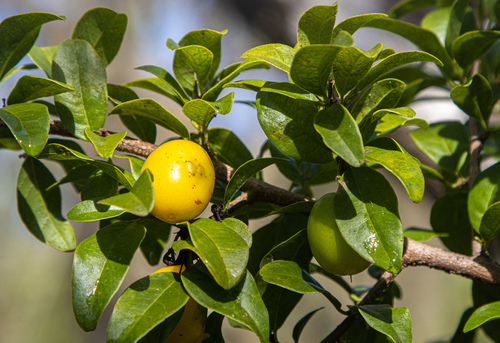
About Ximenia americana L.
Ximenia americana L., commonly known as tallow wood, hog plum, yellow plum, sea lemon, or pi'ut (Chamorro), is a bush-forming shrub or small tree belonging to the Ximenia genus in the Olacaceae family. It occurs mainly in tropical regions, ranging across Africa, India, southeast Asia, Australia, New Zealand, the Pacific Islands, the West Indies, and Central, North, and South America, and is especially common in Africa and South America. This species has never been domesticated, so it only grows in the wild. It grows in areas with a mean annual rainfall above 500 mm, at altitudes up to 2000 m, and can be found in a wide diversity of habitats including dry woodlands, hilly areas, coastal bushlands, riverbanks, mangroves, semi-arid bushlands, moist woodlands, sandy open woodlands, countryside, shrub savannahs, forest lands, watercourses, and stony slopes. While it can grow on many soil types including clay, clay-mud, and silt-sandy soils, it is most often found on poor and dry soils. Ximenia americana is a facultative hemiparasite: its roots can absorb water and nutrients from the roots of other nearby host plants, and can also attach to objects like plastic or rocks, but this is not required for survival, and it can grow perfectly well without a host. This trait means it grows better in soil where it can contact other plants' roots. It is a long-lived perennial plant. In savannahs, one of its common natural habitats, it is an important food source for local wildlife. Giraffes feed on its leaves, and its leaves are also eaten by insects including the butterfly species Axiocerses amanga (bush scarlet), Stugeta bowkeri (Bowker's sapphire), and Hypolycaena philippus (purple-brown hairstreak), along with their larvae. It often produces large quantities of brightly colored fruit in early summer, which attracts birds such as bulbuls, starlings, and barbets, as well as other wildlife that feed on the fruit. Its flowers attract many insect pollinators, specifically bees, including the documented species Agapostemon splendens (brown-winged striped-sweat bee), Apis mellifera (western honey bee), Augochloropsis sumptuosa, Coelioxys germana, Dialictus placidensis, Megachile mendica (flat-tailed leaf-cutter bee), and Melissodes communis (common long-horned bee). Regarding toxicity, leaves of Ximenia americana contain 100 ppm of the cyanogenic glycoside sambunigrin, which is fatal to Bulinus globus, the freshwater snail that spreads schistosomiasis. In 14-day toxicity studies of the plant extract, no test animal deaths occurred, but after oral administration of 2000 mg·kg−1, forced breathing and analgesia were observed in test animals. Another study on liquid extracts from the plant's root, stem, and leaves found that the extracts caused damage to liver cells. No cases of domestication of Ximenia americana have been recorded, but it can be easily propagated by planting fresh seeds in a mixture of 5 parts soil and 1 part compost. Germination typically occurs 14 to 30 days after planting. It grows at a moderate rate, adding roughly 0.5 m (1.6 ft) of growth per year. It is adaptable to loam, clay, and other poor and dry soil types, and can tolerate a range of soil pH levels. It is drought-resistant, making it a reliable food source during dry periods, can tolerate short periods of mild flooding from storms or floods, and has mild tolerance for salty soils and salt-laden winds. Because of its semiparasitic roots, it grows well near other plants, and is best grown next to a host species such as oak. Ximenia americana is used as food, primarily for its fruit. The fruit can be eaten raw or pickled, can replace lemon in fish recipes, and is used to make juice, jams, or intoxicating drinks; in South Africa, a type of beer is produced from its fruits. The fruit kernel can be processed into oil, which is used in cooking as a substitute for butter or ghee. Nuts of this species have a strong purgative effect, so they should not be eaten in large quantities. In Asia, young leaves of the plant are cooked and eaten as a vegetable. However, the leaves contain cyanide, so they must be thoroughly cooked and should not be eaten in large quantities. Traditional medicine uses preparations of Ximenia americana in forms including infusions, decoctions, syrups, cataplasms, and tinctures.

