About Xestospongia muta (Schmidt, 1870)
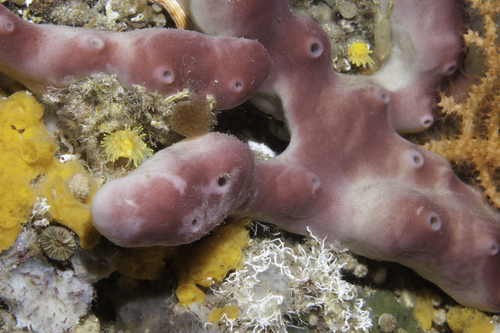
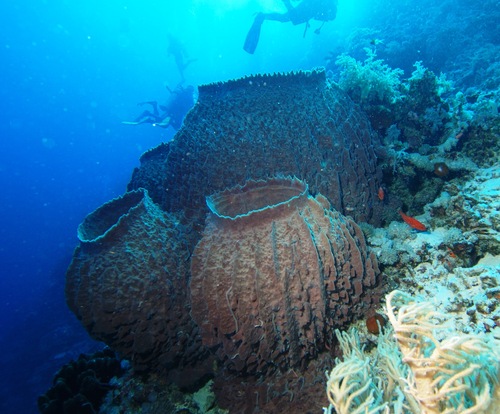
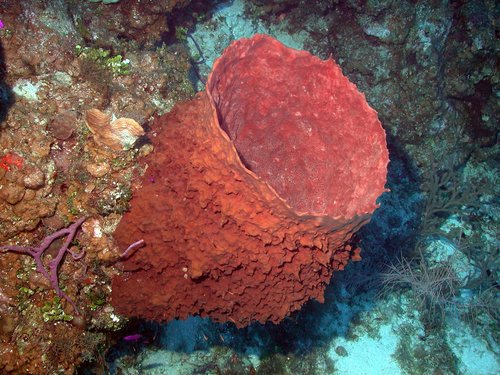
Xestospongia muta, commonly called the giant barrel sponge, is variable in form. It is very large and firm, and is typically barrel-shaped, with a cone-shaped cavity at the apex called the osculum. However, some individuals in the same population may be low and squat, or relatively tall and thin. Similarly, its surface can range from smooth to rough, rugged, and irregular, and sometimes has buttresses. In shallow water, its color ranges from brownish-red to brownish-gray; at greater depths, in caves and underhangs, or when the sponge undergoes cyclic bleaching events, it is pinkish or white. The giant barrel sponge is common on reefs throughout the Caribbean Sea, the Bahamas, and Bermuda, as well as on the reefs and hard-bottom areas of Florida and the Gulf of Mexico. In terms of benthic surface coverage, it is the second most abundant sponge on reefs in the Caribbean region. On reefs off the Florida Keys, it can be as common as two individuals per square metre (yard), and the total biomass of this sponge is greater than that of any other benthic invertebrate. The sponge grows on any hard surface; the smallest individuals ever observed are about 1 cm. Two or more closely related species that are visually indistinguishable from X. muta are found on reefs in the Pacific and Indian Oceans, most notably Xestospongia testudinaria. The tissues of the giant barrel sponge contain photosynthetic symbiotic cyanobacteria, Synechococcus spongiarum, which give the sponge its color. Individuals may undergo periodic bleaching, but this is a cyclic event, and the sponge recovers its normal coloration over time. This cyclical bleaching is likely a response from the cyanobacteria rather than the host sponge, and it has no negative effect on the host sponge. Unlike coral bleaching, X. muta does not appear to rely on its photosynthetic symbionts for nutrition, and the symbionts are considered commensals. Unrelated to cyclic bleaching, X. muta can develop a pathogenic condition called "sponge orange band" that can result in the sponge's death. The cause and transmission of this pathogenic condition remain unknown. The giant barrel sponge is an important member of the reef community. Sponges filter large amounts of water, and form a predominant link in benthic-pelagic coupling on reefs. They also host diverse assemblages of bacteria that can participate in nitrification and carbon fixation. The giant barrel sponge provides habitat for various invertebrates that live on its surface or inside it, and is grazed upon by some species of parrotfish. It is also host to a diverse community of microbes, some of which are primary producers or involved in nitrification.