About Xestobium rufovillosum (De Geer, 1774)
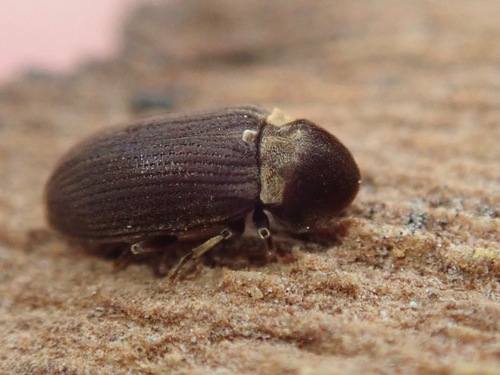
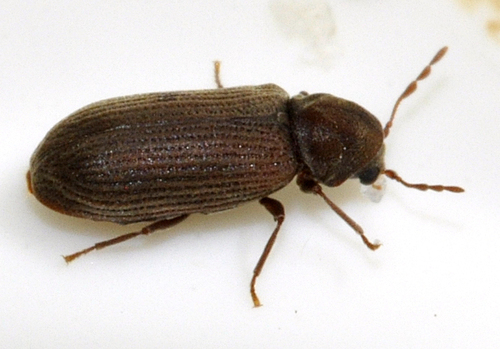
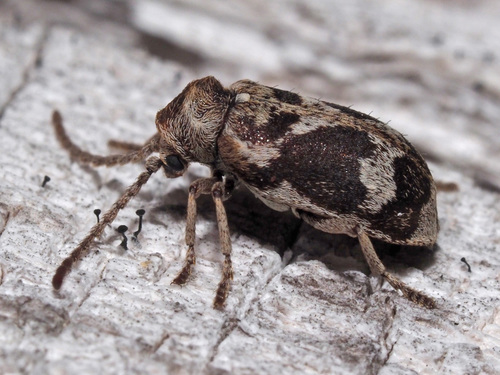
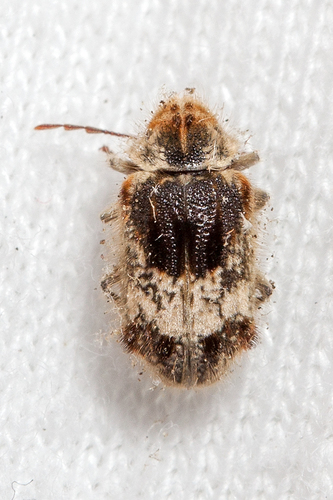
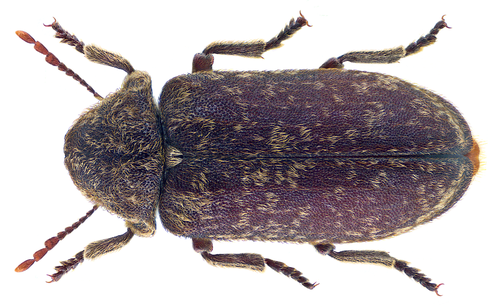
Xestobium rufovillosum, commonly called the deathwatch beetle, has distinct physical traits across all of its life stages. Its eggs are white, slightly pointed at one end, and sticky, with an average size of 0.7 mm (~0.03 in) long and 0.5 mm (~0.02 in) wide. Larvae are creamy-white with six legs, black jaws, and a pair of eyespots on each side of the head. They reach a maximum length of about 11 mm (0.4 in), making them the largest Ptininae found in Britain. These larvae are easily distinguished by their swollen thoracic region and multiple golden setae. When newly formed, the pupa is shiny and milky white. It gradually darkens as it develops eyes, tarsi, and "teeth"; during this pupal stage, the developing beetle completes its metamorphosis, forming a full head, complete eyes, mouthparts, antennae, and legs. The pupa measures 7–8 mm in length and around 3 mm in width. Adult deathwatch beetles have a cylindrical body shape, with an average length of 6 to 7.5 mm (0.24 to 0.30 in). Most of the head is concealed by a brown thoracic shield. The shield and elytra are dark brown or reddish-brown, marked with patchy short yellowish-grey hair felting. The antennae have eleven segments, with the three distal segments somewhat enlarged. This beetle is distributed across Europe (including the United Kingdom), as well as North America, Corsica, Algeria, and New Caledonia. Its natural habitat is dead or decaying hardwood, and in some cases coniferous wood, particularly when the wood has been softened by fungal attack. This preference may be linked to how fungal decay alters nitrogen metabolism in the deathwatch beetle. Decayed wood is also much easier for deathwatch beetle larvae to bore into, which lets them develop more quickly. Sapwood is more nutritious, and is typically attacked first, followed by decay-softened heartwood. Oak (Quercus spp.) is the main host tree, with American oaks being more susceptible to attack than European oaks. Pollarded willow is also attacked by the species in the United Kingdom. The beetle does not infest recently dead wood; around sixty years must pass after an oak dies before the wood becomes a suitable habitat. These beetles will remain on the same piece of wood for multiple generations, until all available resources are used up and the wood can no longer support the population. In Britain, adult deathwatch beetles emerge in April, May, or June. Males emerge first, and females are ready to mate immediately after emerging, most often in the afternoon. Emergence only happens when temperatures are above 10 °C (50 °F). Mating occurs in a concealed spot, usually on the wood surface, and lasts approximately one hour. Females lay their eggs in wood crevices, or in the holes left by previously emerged beetles. Adult beetles do not feed, so they die within a few weeks of emerging. By the time they die, a female may have laid 40 to 80 eggs in small batches. Eggs hatch after around one month. Newly hatched larvae are very small, and chew their way into the timber to feed on the wood. Larval growth is slow: it can take anywhere from two to ten years, or even longer, for larvae to reach full size. Once fully grown, larvae pupate in a chamber near the wood surface. Adults emerge through a newly created exit hole 20 to 30 days after pupation, or may wait to emerge until the following spring, around eleven months after pupation forms. In buildings, deathwatch beetles infest old oak timbers, especially those that have already undergone fungal decay, most commonly from the fungus Donkioporia expansa. This fungus affects damp timber, and often enters wood where rafters or joists are embedded in stone walls, or near leaking roofs or overflowing gutters. Structural damage to infested buildings is not caused by adult beetles, but by larvae tunneling through the wood. While raw wood is difficult to digest, the enzymes in larval guts can digest the cellulose and hemicellulose that make up wood cell walls if the wood has been softened by fungal decay. This allows larvae to access and use the protein, starch, and sugars contained within the wood cells. The steely blue beetle (Korynetes caeruleus) is a predator of both the deathwatch beetle and the common furniture beetle (Anobium punctatum). Adult female steely blue beetles lay their eggs in the exit holes created by emerging wood-boring beetles. The carnivorous steely blue beetle larvae then move through the galleries made by wood-borers, feeding on the wood-borer larvae. Adult deathwatch beetles are weak fliers, and often run across timber surfaces instead of flying. They are sometimes captured by spiders, and their silk-encased husks can be found in spider webs.