About Xestia triangulum Hufnagel, 1766
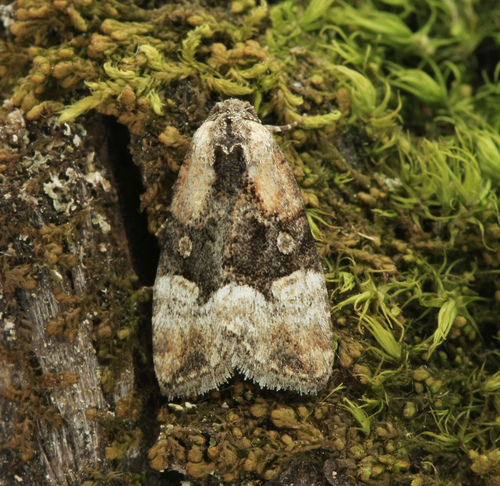
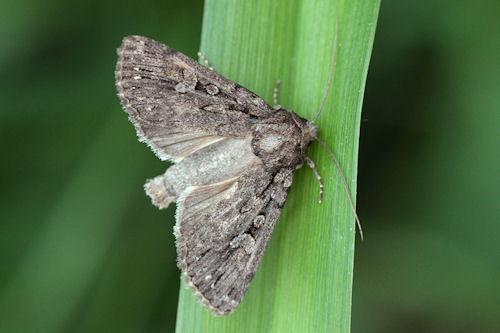
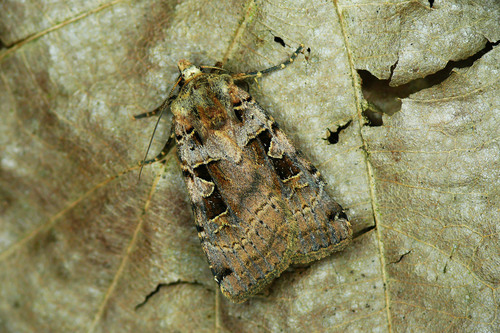
The double square-spot, with the scientific name Xestia triangulum Hufnagel, 1766, is a moth species that belongs to the family Noctuidae. This moth is distributed across most of Europe, excluding Mediterranean islands and northernmost Fennoscandia. In eastern regions, its range extends across the Palearctic to Siberia; in the southeast, it reaches as far as the Black Sea and Iran. In the Alps, it can be found at elevations up to about 2,000 metres (6,600 ft). This species has pale brown forewings marked with two distinct black markings. Despite its common name, only one of these two marks is square-shaped, while the other is roughly triangular. Its hindwings are similar in color to the forewings. Xestia triangulum is very similar in appearance to the related species Xestia ditrapezium. The distinguishing differences between the two are as follows: Xestia ditrapezium has forewings that are on average narrower (or longer) than Xestia triangulum. The forewing ground color of X. ditrapezium is usually darker, ranging from red to violet-brown, and its hindwing color is a shade lighter than that of X. triangulum. The hindwings of X. ditrapezium are significantly lighter than its own forewings, and its collar is nearly monochromatic with no strong contrast. In comparison, X. triangulum has forewings that are on average wider (or shorter), with a usually lighter forewing ground color ranging from ochre to tawny or grayish brown. The hindwing of X. triangulum is typically slightly darker gray, and is about the same lightness as its forewings. The lower part of X. triangulum's neck collar is gray, separated from the dark upper section by a light line. The wingspan of this moth measures 36–46 mm (1.4–1.8 in). For the typical form, forewings are grey brown with a rufous tinge; a small blotch at the base, a preapical costal spot, and the cell are prominently black brown, and the hindwing is fuscous. In the British Isles, this moth flies at night during June and July. It is attracted to light, sugar, and flowers such as wood sage. The larva of Xestia triangulum is ochreous brown with black speckling, has pale lines, and features a row of oblique dark subdorsal bars. It is polyphagous, feeding on a wide variety of plants that include birch, blackthorn, bramble, dock, hawthorn, raspberry, and sallow. The species overwinters in the larval stage. Its preferred habitats are forest edges, shrub-covered slopes, heaths, gardens, and parkland.