About Xerus rutilus (Cretzschmar, 1828)
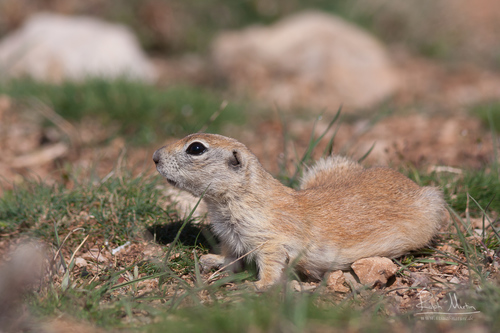
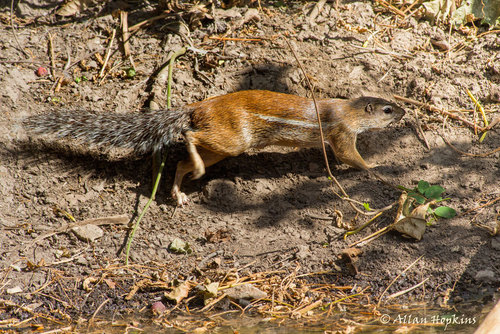
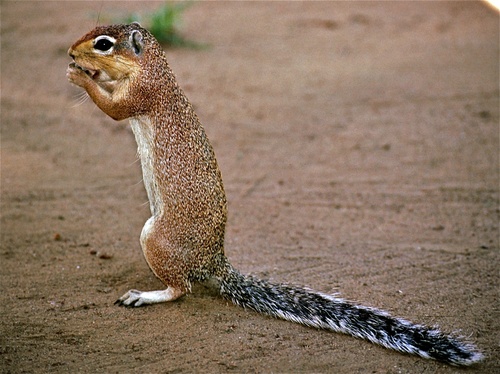
This species, commonly called the unstriped ground squirrel, has the scientific name Xerus rutilus (Cretzschmar, 1828). Individuals are brownish or tawny in overall color, with a lighter colored front. As its common name suggests, X. rutilus differs from other African ground squirrel species by lacking longitudinal white stripes that run along its back. A ring of white hair surrounds each eye, and all observed specimens have coarse body hair. On average, the combined head and body length measures 225.8 millimeters (8.89 inches), with an average tail length of 172 mm (6.8 in). The tail has a flat appearance. Body weight varies across different studies and habitats, ranging from 257.7 to 420 grams (9.09 to 14.82 oz). Hind foot length falls between 35 and 49 mm, the braincase measures only 24 to 25 mm in length, and mandible length varies from 31.0 to 33.9 mm. Xerus rutilus belongs to the tribe Xerini. It is distinct from its sister species Xerus daamsi, and both are separate and distinct from the North African ground squirrel genus Atlantoxerus. Compared to arboreal squirrels native to the same region, X. rutilus has shorter vibrissae (whiskers) and a smaller brain size; these traits are similar to other terrestrial squirrels. No significant sexual dimorphism has been recorded for this species. The unstriped ground squirrel is endemic to Ethiopia, Kenya, Sudan, Tanzania, Djibouti, Eritrea, and Uganda, and it is probably currently present in Somalia. Its natural habitats are dry arid savanna and subtropical or tropical dry shrubland. In northeastern Africa, its populations occupy many areas that overlap with the range of its relative, the African striped ground squirrel (Euxerus erythropus). X. rutilus digs and lives in burrows in generally arid environmental conditions.