About Xerus inauris (Zimmermann, 1780)
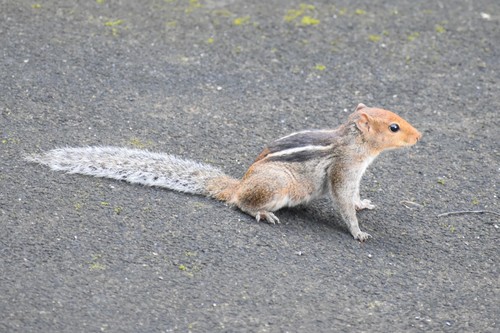
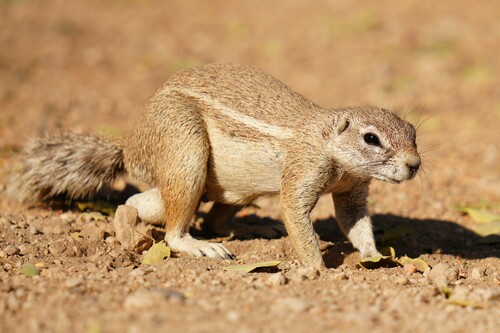
The Cape ground squirrel (Xerus inauris) has black skin covered in a coat of short, stiff hairs, with no underfur. Its back fur is cinnamon-colored, while the face, underbelly, sides of the neck, and ventral sides of the limbs are white. Each side of the body has a white stripe that runs from the shoulder to the thigh. Its eyes are fairly large, marked with white lines around them, and its pinnae are small. The tail is flattened on the back and underside, covered in white hair, with two black bands at the base. Sexual dimorphism in this species is subtle. Males typically weigh between 423 and 649 grams, an 8 to 12 percent increase over female weights, which range from 444 to 600 grams. Total length for males measures 424 to 476 millimetres, compared to 435 to 446 millimetres for females. This species has a dental formula of 1.1.0.0 / 1.1.3.3. Female Cape ground squirrels have two pairs of mammary glands, one on the belly and one in the groin area. Males have a large glans penis with a prominent baculum, and this species is well known for its large testicles, roughly the size of a golf ball and around 20% of the length of the head and body. The species moults once per year, with moulting periods between August and September, and between March and April.
The Cape ground squirrel is widespread across southern Africa, occurring in Botswana, South Africa, Lesotho, and Namibia. Most of Namibia falls within its range, though it is not found in coastal regions or the northwest. In Botswana, it inhabits the central and southwestern Kalahari. In South Africa, it is found in central and north-central areas.
Cape ground squirrels live primarily in arid or semiarid areas. They prefer veld and grasslands with hard ground, and can also be found in scrub along pans, on floodplains, and in agricultural areas. They are generally active during the day and do not hibernate. They are burrowing animals that dig and live in clusters of burrows that average around 700 square metres, with between 2 and 100 entrances. Burrows protect the squirrels from extreme surface temperatures and from predators. Despite this, most of the day is spent feeding above ground. Cape ground squirrels shade their head and back with their bushy tails, a behavior originally thought to be important for thermoregulation. However, research has shown that raising the tail does not actually decrease core body temperature, and instead mostly serves to cool the skin and improve thermal comfort while foraging in hot sun between trips to burrows. Burrowing itself has been found to lower the squirrel's core body temperature by a few degrees Celsius. Squirrels leave their burrows earlier in the morning during summer months to avoid midday heat, and in winter months their core body temperature rises quickly once they exit their burrows. They also engage in dust bathing.
Cape ground squirrels eat bulbs, fruits, grasses, herbs, insects, and shrubs. They forage every day and do not hoard food. They usually do not need to drink, as they get all the moisture they require from their food. Around 70% of a Cape ground squirrel's daily activity is spent feeding, 15 to 20% is spent being vigilant, and around 10% is spent socializing. These squirrels use the sun's position as an orientation marker when hiding and recovering food. Cape ground squirrel burrows are also used by meerkats and yellow mongooses. Cape ground squirrels and meerkats appear to have a mutual relationship, while the relationship between squirrels and yellow mongooses is more commensal. Predators of Cape ground squirrels include jackals, snakes, and monitor lizards. Cape ground squirrels can distinguish between the scents of droppings from predators and non-predators. When threatened by predators, they engage in mobbing behavior: multiple squirrels rush toward the predator while blocking it with their bushy tails. All squirrels retreat if the predator strikes back, but repeated mobbing is usually successful at driving predators away.
Cape ground squirrels mate and reproduce year-round, though most mating occurs during dry winter months. Females copulate with multiple males, so males' large testicles are an advantage for sperm competition. After copulation, males will masturbate, a behavior that may help keep their genitals clean and reduce the risk of sexually transmitted infections. In social groups, only one female enters oestrus at a time, and oestrus lasts around three hours. Gestation lasts approximately 48 days, or between 42 and 49 days. Lactation starts shortly before pups are born. A lactating female isolates herself in a separate burrow to care for her young, but returns to her original group after weaning, or if her litter is lost. Litters contain between 1 and 3 pups. Pups are born altricial, hairless, and blind. They remain in the burrow for their first 45 days. Their eyes open by 35 days after birth. Seven days after they first emerge from the burrow, pups are able to eat solid food. Lactation ends at around 52 days. Males reach sexual maturity at eight months old, while females reach maturity at 10 months old. Males leave their natal groups, while females stay.