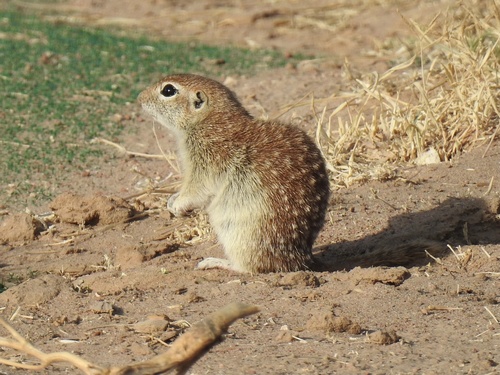
About Xerospermophilus spilosoma (Bennett, 1833)
The spotted ground squirrel (Xerospermophilus spilosoma) is one of the smallest squirrel species that lives in the northern hemisphere. It has many white linear spots along its dorsal region, and a white underbelly. The coloration of the rest of its body varies widely, and can include different shades of brown, black, gray, and white. Its skull is similar in shape to that of the thirteen-lined ground squirrel, but is slightly broader in the interorbital and rostral regions. A distinct characteristic of this species' skull is the presence of especially large auditory bullae. X. spilosoma has two distinct fur coats (pelages) and molts once each year. Adults emerging from hibernation usually have thicker pelages, which they shed by springtime. Juveniles typically have darker pelages than full-grown adults. Fur color can be affected by the local environment: populations in areas with soil-rich terrain tend to have darker coloration than populations living in grasslands. The spotted ground squirrel's range extends from south-central South Dakota, through Nebraska where it occupies the region's sand hills. It is also found in eastern Colorado, northwestern Oklahoma, western Texas, eastern Arizona, western Kansas, most of New Mexico, and southeastern Utah. In Mexico, the species' distribution is restricted to southern and central Mexico. It generally occurs in areas with deep sandy soils, where vegetation is sparse and scattered, matching the environments of its known distribution areas. As a burrowing species, the spotted ground squirrel makes its home in sand hills and dunes, and has even been recorded living in abandoned prairie dog burrows. Spotted ground squirrel burrows are most often found on short-grass mesas or along river banks. The species prefers lighter, looser soil for digging burrows, which is why it lives in arid, dry landscapes that contain this type of soil.