About Xerophyllum tenax (Pursh) Nutt.
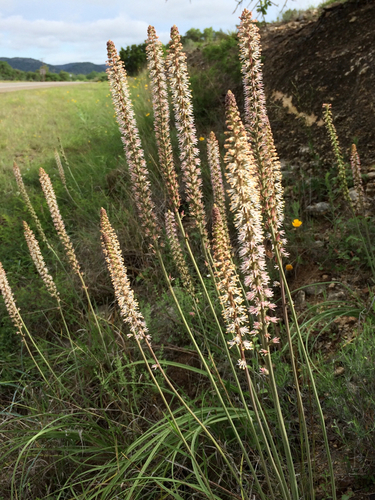
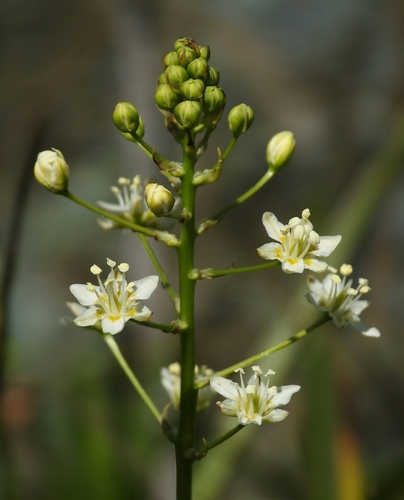
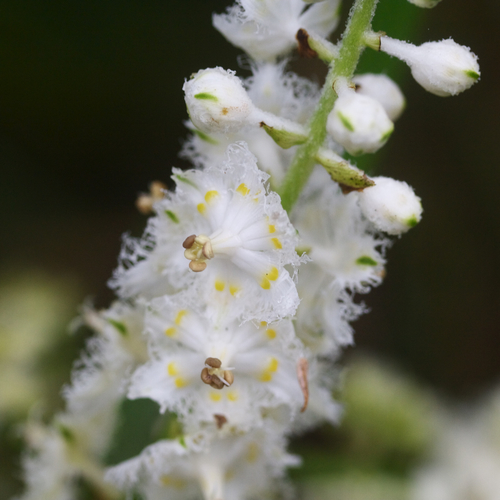
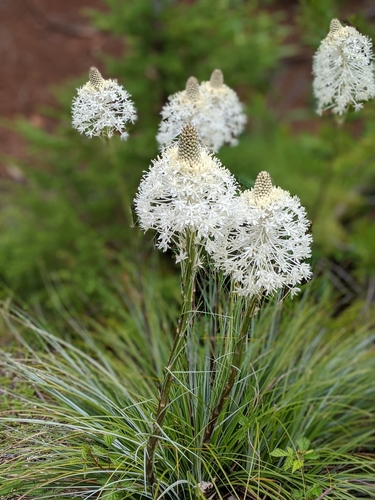
Xerophyllum tenax (Pursh) Nutt. is a perennial herb reaching 15 to 150 centimetres (6 to 59 inches) in height. In preferred habitat and ideal conditions such as ample sunlight, it can grow to just over 1.2 metres (4 feet) tall. It grows in bunches, with leaves wrapping around and extending from a small ground-level stem. Its leaves measure 30 to 100 cm (12 to 39 1/2 in) long and 2 to 6 millimetres (1/16 to 1/4 in) wide, are dull olive green, and have toothed edges. A common myth claims that this plant, commonly called beargrass, blooms every seven years, but in reality it typically blooms at irregular intervals that depend on environmental factors including moisture and temperature. A tightly packed upright club-shaped raceme, emerging from the stalk tip, holds slightly fragrant white flowers, which have six sepals and six stamens. The plant produces small tan-colored seeds that germinate after a 12 to 16 week cold period. Depending on site-specific and environmental conditions, individual plants may bloom every year or only once every decade, and back-to-back blooming for a single plant is rare. This species is found mostly in western North America, ranging from British Columbia south to California and east to Wyoming. It grows in subalpine meadows, coastal mountains, and low ground in the California coastal fog belt as far south as Monterey County. It is common on the Olympic Peninsula, and in the Cascades, northern Sierra Nevada, and Rockies. It typically grows in forest understories, and its growth is closely shaped by light availability, which is often determined by canopy density. Its tall flowering racemes are mainly pollinated by large-bodied insects such as bees, which are attracted by the plant’s floral characteristics. Beargrass density and vigor are more robust in areas with moderate to low canopy cover, where greater light penetration occurs. In denser, shaded forests, the plant tends to be smaller and less productive. Light availability and historical stand disturbances both play key roles in determining the plant’s morphology and reproductive success: beargrass grows larger and reproduces more in open, disturbed habitats. Depending on conditions such as moisture and temperature, it periodically blooms in large concentrated patches. One study found that smoke-water significantly increased beargrass seed germination rates compared to control groups. These results indicate that smoke-water could be an effective tool for promoting beargrass regeneration, particularly at low-elevation sites with altered fire regimes. X. tenax plays an important role in the fire ecology of its native regions. It has rhizomes that survive fires that clear dead and dying plant matter from the ground surface. The plant thrives with periodic burns, and is often the first plant to resprout in an area scorched by fire. Deer and elk eat the flowers and other parts of the plant. Bears eat the softer leaf bases, which is thought to have influenced the plant’s common name beargrass, alongside its native habitat. The plant’s fibrous leaves turn white when dried, and are tough, durable, easily dyed, and easy to manipulate into tight waterproof weaves. Native Americans, including the Hupa, wove this plant into baskets; the Hupa use it to create border patterns. Historically, Native Americans roasted the rootstock of X. tenax for food, and also ate the cooked pods, which are good when prepared this way. They also braided dried leaves to use as decoration on traditional buckskin dresses and jewelry.