About Xerophyllum asphodeloides (L.) Nutt.
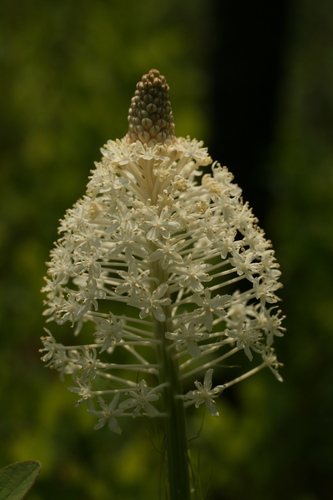
Xerophyllum asphodeloides (L.) Nutt. is a North American flowering plant species belonging to the Melanthiaceae family, with common names including turkey beard, eastern turkeybeard, beartongue, grass-leaved helonias, and mountain asphodel. It is native to the eastern United States, occurring in the southern Appalachian Mountains from Virginia to Alabama, and also in the Pine Barrens of New Jersey. This species is a rhizomatous perennial herb that grows up to 1.5 meters tall. Its leaves range from threadlike to linear in shape, have serrated edges, and can reach up to 50 centimeters in length. The inflorescence is a long raceme of flowers that each have six cream-white tepals, and the fruit it produces is a capsule. A wide range of species are commonly associated with Xerophyllum asphodeloides: Quercus prinus (chestnut oak), Quercus marilandica (blackjack oak), Pinus echinata (shortleaf pine), Quercus stellata (post oak), Sassafras albidum (sassafras), Pinus rigida (pitch pine), Aster dumosus (aster), Aster paternus (white-topped aster), Cypripedium acaule (pink lady's-slipper), Polygonella articulata (jointweed), Solidago odora var. odora (sweet goldenrod), Solidago puberula var. puberula (goldenrod), Trichostema dichotomum (blue curls), Gaylussacia baccata (black huckleberry), Hudsonia ericoides (golden heather), Hudsonia montana (mountain heather), Ilex glabra (inkberry), Kalmia angustifolia (sheep laurel), Leiophyllum buxifolium (sand myrtle), Lyonia mariana (staggerbush), Myrica caroliniensis (bayberry), Pyxidanthera barbulata (pyxie-moss), Quercus ilicifolia (bear oak), Rhus copallinum (winged sumac), Vaccinium corymbosum (highbush blueberry), and Vaccinium pallidum (hillside blueberry). This plant is most common in New Jersey and Virginia, and is less common across the rest of its native range. It is currently threatened by habitat loss, habitat fragmentation, and fire suppression.