About Xerolenta obvia (Menke, 1828)
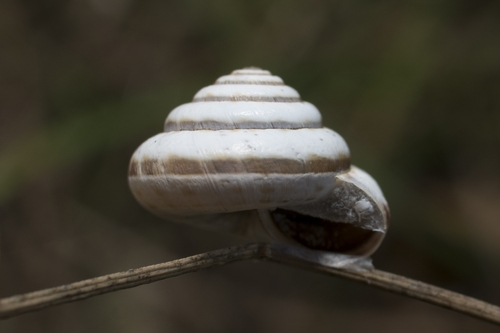
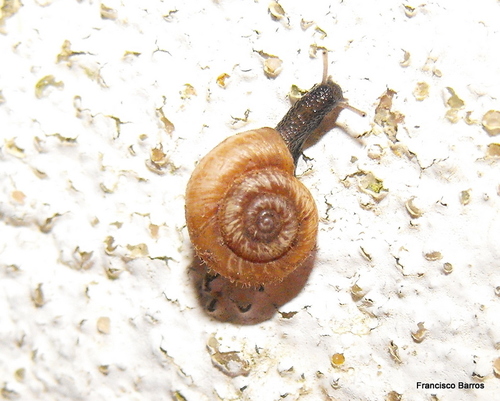
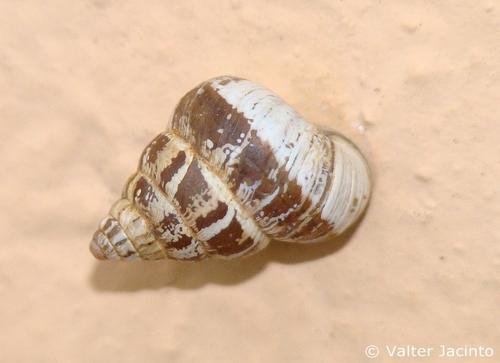
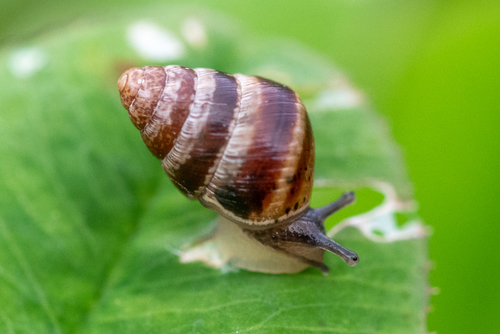
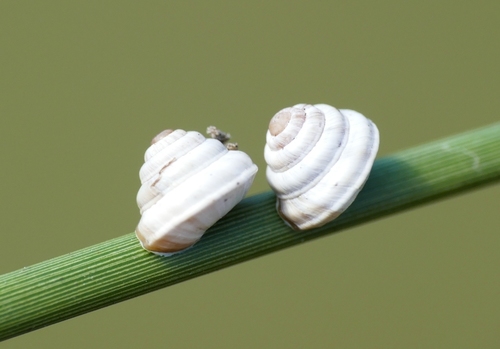
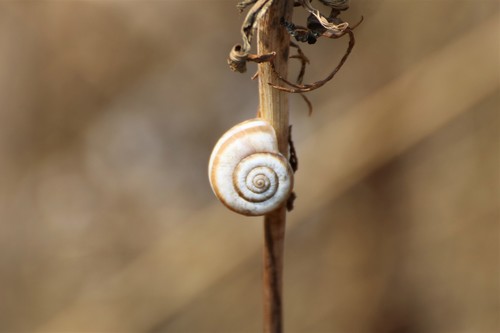
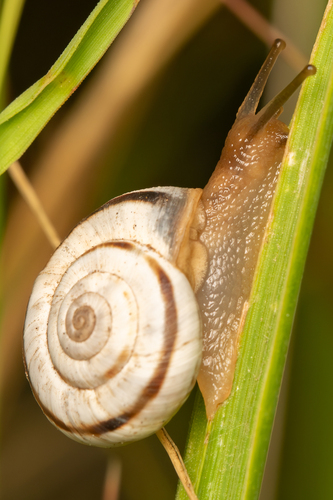
Description and identification: Adult Xerolenta obvia have shells that are 7–10 mm high and 14–20 mm wide, giving the shell a relatively flat shape. The shell holds up to 5–6 whorls, and its umbilicus is approximately 1/4 the total width of the shell. Shells are thick, opaque, and nearly smooth, with only fine, irregular striations. Their base color is white or yellowish-white, and is most commonly marked by highly variable dark-brown to almost-black spiral bands. When individuals reach maturity, the body whorl barely descends more steeply, no rib develops inside the aperture, but the umbilicus widens, which makes the center of the spiral appear more eccentrically placed. In Central Europe, X. obvia is most easily confused with Cernuella neglecta and Helicella itala. C. neglecta develops a brown rib inside the aperture when fully grown. H. itala has a somewhat wider umbilicus, around 1/3 the width of the shell, and its body whorl shifts downwards before growth stops. The clearest distinguishing feature between these species is the structure of the two dart sacs. In X. obvia, the dart sacs are symmetrical and diverge from the vagina at their slightly angular tips, a shape compared to angels' wings. In contrast, H. itala has longer dart sacs that are closely bound to the vagina, while in C. neglecta the sacs are connected and overlap one another on one side of the vagina.
Habitat and Distribution: This species is found in dry, exposed grassland, and often occurs in ruderal sites. It has been recorded at altitudes up to 2000 m in the Swiss Alps, and frequently occurs at very high population densities. X. obvia is thought to be native to the Balkans and parts of eastern Europe. In the Czech Republic and Slovakia, two fossil specimens date to the middle Holocene (over 4200 years before present), though most fossil finds in the region are from later periods. The species has been introduced to a wider area since the end of the 19th century, and now ranges from Asia Minor to Spain, and north to Scandinavia. It has also been introduced to Canada, where it was first detected in Bethany, Ontario in 1969, and had at least 23 recorded occurrences in southern Ontario as of 2015. In the United States, it has been found in Wayne County, Michigan since 2001, and in Montana since 2012. In the USA, this introduced species is considered a potentially serious invasive threat that could harm agriculture, natural ecosystems, human health, or commerce. Control efforts have been carried out for introduced populations in the USA and Spain, and it has been recommended that the species be given top national quarantine priority in the USA.