About Xerocomellus zelleri (Murrill) Klofac
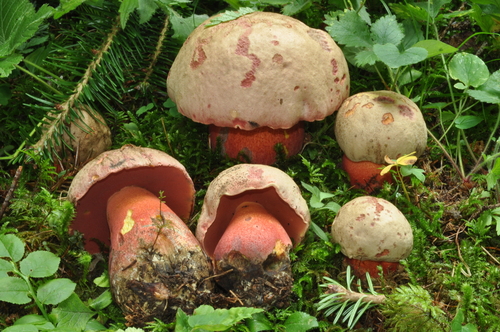
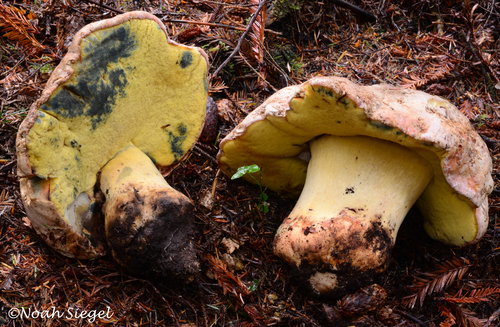
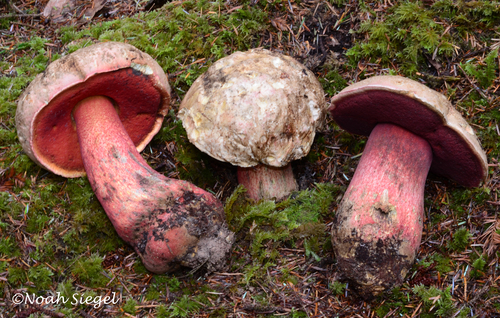
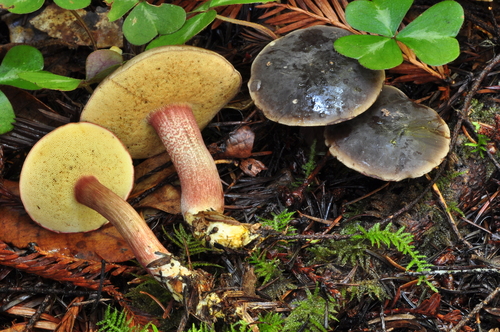
This species, scientifically named Xerocomellus zelleri (Murrill) Klofac, has a cap that typically measures 3–16 cm (1+1⁄8–6+1⁄4 in) in diameter. It starts out convex and flattens somewhat as it matures. The cap is fleshy, with an uneven velvety surface, and colored dark brown to nearly black; the cap margin is pale cream. Young specimens are covered in a grayish bloom. The tubes making up the hymenium (the undersurface of the cap) are up to 1.5 cm (5⁄8 in) long, angular, and yellow, changing to dirty yellow and finally greenish-yellow. There are 1–2 pores per millimeter on the hymenium surface, and the pores may turn slightly brownish after being exposed to air for some time. The flesh is yellow to dirty yellow, up to 1.5 cm (5⁄8 in) thick, and bruises blue inconsistently when cut or broken. The stem grows up to 12 cm (4+3⁄4 in) tall and 1–3 cm (3⁄8–1+1⁄8 in) thick, and is swollen toward the base. The stem surface is red or yellowish with red lines, and is often white or yellow at the base; it is solid (not hollow) with fibrous flesh, and ages to yellowish-red to dark red as the mushroom matures. The spore print is olive-brown, and one source notes it may be juicy. Spores are ellipsoid in shape, smooth, and measure 12–16 by 4–6 μm, though occasionally "giant spores" up to 24 μm long are present. The spore-bearing cells, called basidia, measure 26–35 by 9.5–12 μm and are four-spored. Cystidia are roughly cylindrical and thin-walled, with dimensions of 38–77 by 5.5–14.8 μm. There are no clamp connections in the hyphae. When a drop of ammonia solution is applied to fruit body tissue, it stains greenish. Xerocomellus zelleri grows singly or in small groups on the ground or in forest duff in mature coniferous forests. It is occasionally abundant on grassy forest edges, and rarely grows on badly decayed conifer logs. This is an ectomycorrhizal mushroom: the fungal hyphae form sheaths around the rootlets of certain trees, and exchange nutrients with the host tree in a mutualistic relationship. The fungus associates with alder, poplar and other hardwoods, and laboratory culture has shown it can form ectomycorrhizae with Western Hemlock (Tsuga heterophylla). It may have saprobic tendencies, however, as it has been recorded growing under California Redwood – sometimes in the rotted wood of old trunks – and California Redwood is not known to form mycorrhizae. The species forms long rhizomorphs (hyphal aggregations that resemble roots), and has been noted to be more abundant in sites with buried wood than in those without. In British Columbia, it occurs from summer to early winter, and also appears infrequently in early spring. In California, it often fruits from after the autumn rainy season through to March or April. Its dark cap coloring makes Xerocomellus zelleri hard to spot, "unless a glimpse of the yellow hymenium is obtained". Fruit bodies are eaten by the American shrew-mole. Xerocomellus zelleri is distributed in North America, ranging from the Pacific Northwest south to California and Mexico. In Mexico, it has been reported in high-altitude cloud forests of Mexican Beech (Fagus mexicana), a rare and endangered habitat. It has also been reported from Tibet, but this record is likely based on a misidentification.