About Xerocomellus porosporus (Imler ex Watling) Šutara
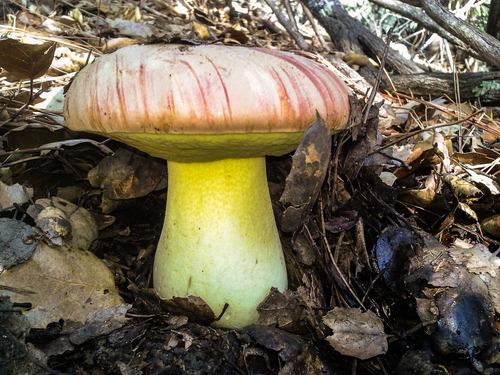
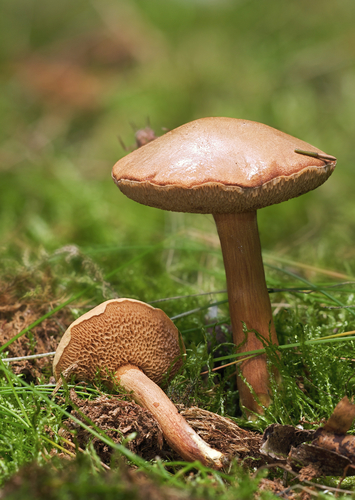
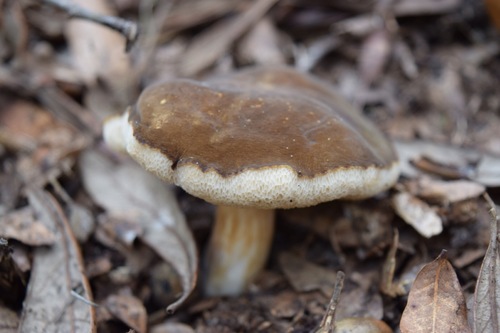
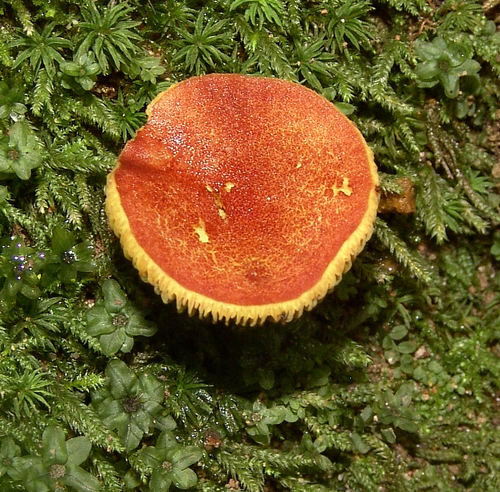
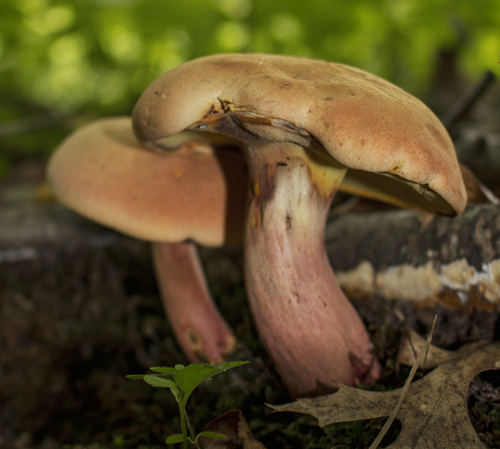
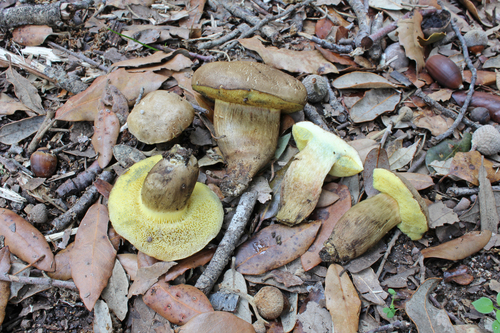
When fully expanded, the caps of Xerocomellus porosporus reach up to 8 centimetres (3.1 in) in diameter, and develop cracks or fissures early in development. Cap color ranges from putty beige to dull brown or olivaceous. The stem is typically olivaceous, with either a red zone in the upper section or faint reddish spots in the lower section. It is more yellow at the apex, bruises brown when damaged, and darkens to dark brick or vinaceous toward the base. The tubes measure 13 to 20 millimetres (0.51 to 0.79 in) long; they start lemon yellow, turn olivaceous with age, and bruise bluish when damaged. The pores are narrow, 0.2–0.5 mm in diameter, angular in shape, lemon yellow when young, darken with age, and also bruise blue when damaged. The flesh is pale lemon yellow or buff in the cap, and chrome yellow in the stem apex. Hyphae of this species do not have clamp connections. No amyloid or dextrinoid reactions were detected in any part of the fruit body. Spores produce an olive-brown spore print. Microscopically, this bolete has truncate (cut off at the end) spores, with spore dimensions of 13–15 by 4–5 μm. Xerocomellus porosporus occurs occasionally in autumn, growing singly or in small groups in mixed deciduous woodlands, most often in association with oak, hornbeam, and beech. This species is widespread across northern temperate zones, but is somewhat rare in Europe.