About Xenus cinereus (Güldenstädt, 1775)
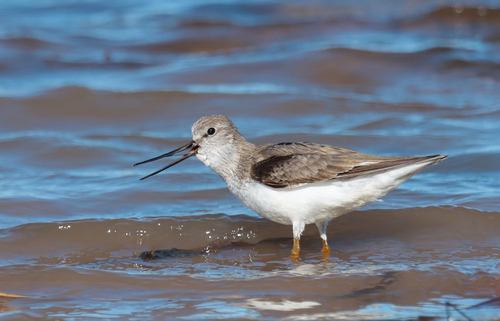
The Terek sandpiper, with the scientific name Xenus cinereus (Güldenstädt, 1775), is slightly larger than the common sandpiper, measuring 22–25 cm (8.7–9.8 in) in length. Its long, upcurved bill is noticeably distinctive, being somewhat similar to an avocet's bill but less strongly curved. As suggested by its scientific specific name, this wading bird has a grey back, face, and breast across all plumages, with a more or less distinct white supercilium. Its belly is whitish, its feet are yellow, and its bill has a yellowish base with a black tip. Its call is a high whistle. This bird breeds near water in the taiga zone, ranging from Finland through northern Siberia to the Kolyma River. It migrates south for the winter to tropical coasts in east Africa, south Asia, and Australia, where it usually prefers muddy areas. It is a rare vagrant in western Europe. During autumn migration, it is sometimes observed passing through the Marianas. It is decidedly uncommon on Palau, which lies further from its typical migration route. Almost every year, and increasingly more often in recent times, a small number of individuals stray to Alaska and the Aleutian and Pribilof Islands. Every few years, individual vagrants are recorded in the Neotropics; they arrive there either as migrating birds from Africa, or as North American strays that accompany local waders south for winter. These vagrants have been recorded as far south as Argentina. Overall genetic variation in Terek sandpipers across their entire range is low, with some evidence of population contraction followed by later expansion. However, the geographically isolated Dnieper River population in Eastern Europe does show significant genetic differentiation. The Terek sandpiper feeds in a distinctive, very active way: it chases insects and other mobile prey, and sometimes runs to the water's edge to wash its catch after catching it. It lays three or four eggs in a lined ground scrape. Terek sandpipers like to associate with ruddy turnstones (Arenaria interpres), small calidrids, and Charadrius plovers, though they may not associate with Pluvialis plovers. One vagrant individual found in Paraty, Rio de Janeiro state, was observed pairing with a spotted sandpiper (Actitis macularius). This species is covered by the Agreement on the Conservation of African-Eurasian Migratory Waterbirds (AEWA). Since it is widespread and often quite commonly seen, the Terek sandpiper is not considered a threatened species by the IUCN.