About Xenox tigrinus (De Geer, 1776)
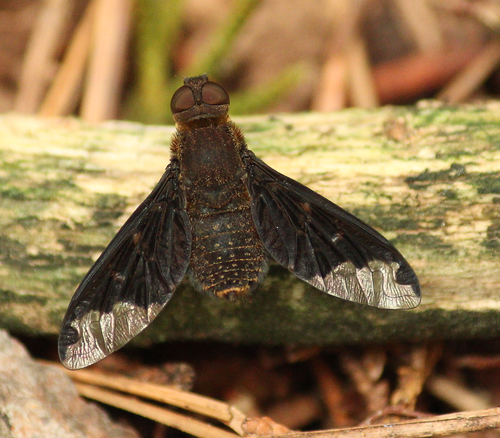
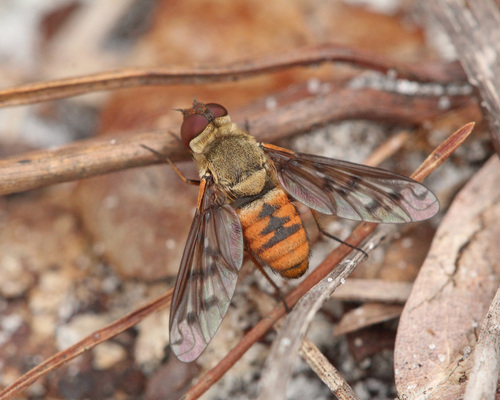
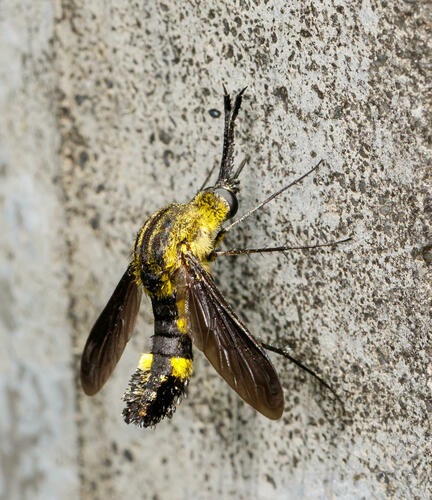
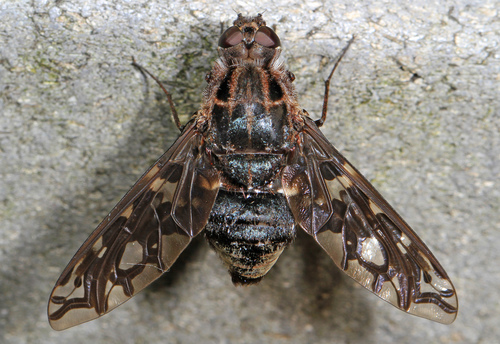
Adults of Xenox tigrinus measure between 11 and 19 millimetres (0.43 to 0.75 inches) in length, a measurement that excludes wings and other appendages such as antennae and legs. Their body is primarily black, with two white spots present on the abdomen, and their transparent wings carry a distinct black pattern. Due to its size and coloration, this species, commonly called the tiger bee fly, is often mistaken for a large bee. Its bee mimicry, which is an instance of Batesian mimicry, helps it avoid potential predators. For its life cycle, female tiger bee flies lay fertilized eggs inside carpenter bee nests. Females do not enter the nest themselves; instead, they place their eggs near the nest entrance. After hatching, the fly larvae feed on carpenter bee larvae. The fly larvae may also wait until the carpenter bees reach the vulnerable pupal stage before consuming them. Xenox tigrinus is the most common parasite of the eastern carpenter bee, Xylocopa virginica. This species is also classified as a pollinator.