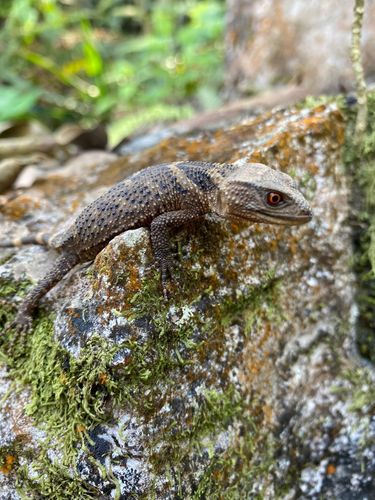
About Xenosaurus grandis (Gray, 1856)
Xenosaurus grandis, commonly called the knob-scaled lizard, is a species of diurnal, terrestrial lizard that is endemic to Mexico and Guatemala. It primarily lives in tropical rainforests, where it dwells in rock crevices and feeds on insects. The species has five distinct major population zones across southern Mexico and Guatemala: central Veracruz, southern Oaxaca, north-central Oaxaca, the highlands of central Chiapas, and central Guatemala. These isolated population groups have resulted in the recognition of five subspecies of X. grandis: X. g. grandis, X. g. agrenon, X. g. arboreus, X. g. rackhami, and X. g. sanmartinesis. All subspecies of Xenosaurus grandis live exclusively in rock crevices, a trait that lets the species occupy a wide range of habitats including xerophytic vegetation, tropical rainforests, cloud forests, oak forests, and tropical deciduous rainforests. These lizards have very strong site fidelity: 95% of their entire lives are spent in just one to two rock crevices. Like all other xenosaurids, Xenosaurus grandis is viviparous, meaning it gives birth to live young instead of laying eggs. Gestation lasts for 9 months before young are born. Most litters contain just three offspring, though litter sizes from two to seven have been recorded. Males of this species reach sexual maturity at 28 months, while females reach maturity slightly later, at 32 months. Current evidence suggests X. grandis does not produce offspring every year.

