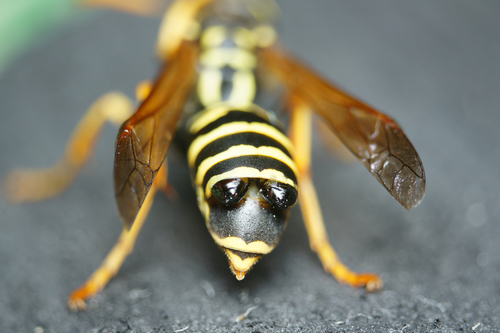
About Xenos vesparum Rossius, 1793
Xenos vesparum Rossius, 1793 displays striking sexual dimorphism linked to its mating system. Both sexes develop inside the abdomen of their wasp host: males pupate and emerge as free-living adults, while females remain permanently inside the host. The first larval stage, called triungulins, and adult males are the only free-living life stages of this species. Triungulins leave the mother’s genital opening by detecting light. They are released either in wasp feeding or mating areas, or directly into a wasp nest, depending on the location of the mother’s host when larvae are released. If released outside the nest, triungulins use chemical cues to find a foraging wasp, cling to it, and are carried back to the nest. Once in the nest, triungulins search for suitable immature wasp hosts at different developmental stages. This host selection process is nonrandom, as the species has a recorded preference for infecting female wasp hosts. Instead of creating a wound to enter the host’s abdomen, the larva enters by mechanically separating the host’s cuticle. This method is critical for delaying or avoiding the initial host immune response that wound formation would trigger. After entering, the triungulin molts into its second larval stage without undergoing ecdysis, a trait unique to strepsipterans. The second and third larval stages grow extensively but slowly, likely to avoid harming the host, since the parasite’s survival depends entirely on the host’s survival. During these stages, X. vesparum can avoid the host’s immune system through both passive and active means. The exact mechanism of this immune avoidance is not known, but it is hypothesized that chemical properties of the parasite’s surface allow it to remain undetected by the host immune system. Molting without ecdysis is thought to help retain this protective concealment, and is considered a preadaptation for the species’ endoparasitic lifestyle. The fourth and final stage of the life cycle involves development into either a free-living male or a neotenic female, followed by full emergence for males and partial emergence for females. The male pupates and develops into his final free-living form, and his pupa protrudes from the wasp host’s abdomen to create an exit route for the adult male. In contrast, the female develops into her final neotenic form and only protrudes far enough from the host abdomen for a male to reach her genital opening, and for her larvae to escape later. The protrusion of the female parasite or male pupa from the host abdomen is called "stylopization", a term referencing the insect family this species belongs to.

