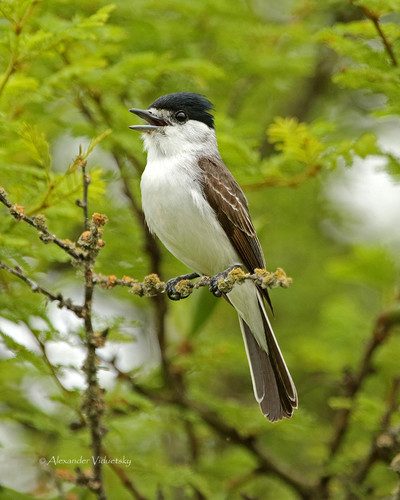
About Xenopsaris albinucha (Burmeister, 1869)
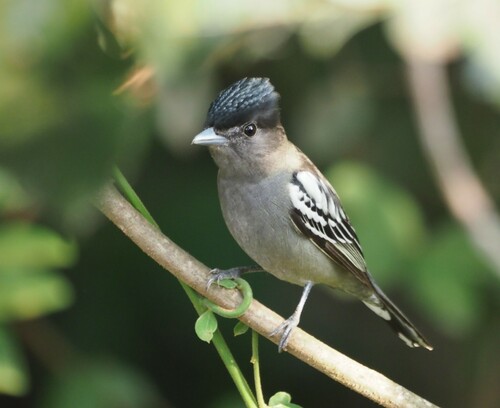
The white-naped xenopsaris, scientific name Xenopsaris albinucha (Burmeister, 1869), is smaller than its close relatives becards and tityras. It measures 12.5 to 13 cm (4.9–5.1 in) in length and weighs around 10 g (0.35 oz). The subspecies X. a. minor has identical plumage to the nominate subspecies, but is smaller in size. For example, the wing-chord (a measurement from the wrist-joint to the end of the wing) of the nominate subspecies ranges 6.4 to 6.6 cm (2.5–2.6 in), compared to 6.0 to 6.2 cm (2.4–2.4 in) for X. a. minor. For this species, the face, lores, throat, breast, belly and rump are white. Undersides are tinged with grey on the chest and yellow on the belly. Males have a glossy black crown. The nape is pale grey, with a grey-white to white band that separates the crown from the back. The wings are dusky greyish brown with white edging on the inner remiges and wing-coverts. The tail is dusky brown, while the stout bill, iris and legs are black. Females are similar to males, but are duller overall and have a chestnut-tinged crown. Juvenile birds resemble adults, but they have greyish napes, more chestnut in the crown, and the feathers of the back, rump and primaries are scalloped with ochre. The secondaries on the wing and the tail feathers are edged with white. The species' song is delicate and does not carry far. It is most commonly heard during the rainy season, but can be heard at any time of day. Per the Handbook of the Birds of the World, the call is described as either a thin, high-pitched and hesitant "teep, tre'e'e'e'e'a eea wu'u'u'e'e'e-e-e-e-e-p" or a "twip, tsiweeé, tseee, ti-ti-ti-ti". The initial trill rises then falls, and the final trill is long. Birds sometimes vary the pattern and only use part of the song. This species also makes a squeaky, undulating screech, and males have been recorded whistling while on the nest. Foraging males have been observed making an ascending "shreee" every few seconds while hunting for insects. The white-naped xenopsaris looks somewhat similar to the cinereous becard, whose range overlaps with the white-naped xenopsaris in Venezuela. It is smaller than the cinereous becard, with a longer tail, thinner bill, whiter underparts (instead of grey) and browner upperparts (rather than greyish). The white-naped xenopsaris has a disjunct distribution. The southern population of the nominate subspecies is widespread from north-eastern Brazil through to Bolivia, Paraguay and northern Argentina and Uruguay. A separate nominate population lives in Guyana. The subspecies X. a. minor is found in west and central Venezuela, and probably extends into north-eastern Colombia. The species is generally resident across its range, but sightings of solitary, silent birds suggest it may be migratory in Bolivia and Brazil. A 2005 study suggested it was migratory in Santa Fe, Argentina, as the species was not observed in the area between March and September (austral winter). In 2006, the species was reported for the first time in Peru. It remained unclear if this record was of a vagrant escaping cold weather or a migrant, as the species is mostly uncommon across its range and the area is poorly studied by ornithologists. The species occupies a variety of habitats across its range, including Caatinga scrubland, riparian (river) woodland, lightly wooded areas, the borders of open gallery forest, and open areas with scattered trees. It usually lives near water or damp areas, and ranges from sea-level to 550 m (1,800 ft) in elevation.