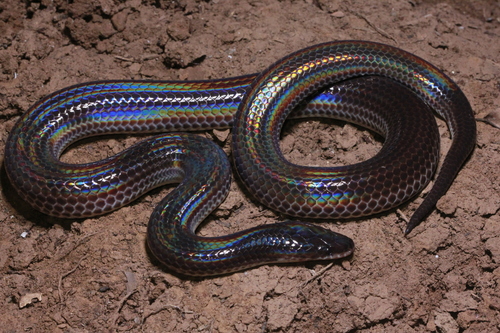
About Xenopeltis unicolor Reinwardt, 1827
Xenopeltis unicolor Reinwardt, 1827 grows to an average length of about 1 m (3 ft 3 in). Its dorsal color is reddish brown, brown, or blackish, and it has an unpatterned whitish-grey ventral surface. As a fossorial (burrowing) species, it has a narrow, wedge-shaped head with little delineation from the neck, a shape that makes it easy to push through soil. Its most defining characteristic is its iridescent, highly polished scales that give this snake its common name. Each scale has a layer of dark pigmentation just below the surface that enhances this iridescence. Juveniles look very similar to adults, except they have a distinct white collar of scales just below the head; this collar fades within the first year of life. This species has two cone opsins, which means it potentially has dichromatic color vision. It has two postocular scales, a supralabial scale formula of 3-2-3, 181–196 ventrals, and 26–31 pairs of subcaudals. It is a primitive snake that shares characteristics with both boas and pythons, and which family it belongs to remains a matter of scientific debate.
This species is found in China (Guangdong and Yunnan), Myanmar, the Andaman and Nicobar Islands, Vietnam, Laos, Cambodia, Thailand, West Malaysia, Penang Island, Singapore Island, East Malaysia (Sarawak), Indonesia (the Riau Archipelago, Bangka, Billiton, Sumatra, We, Simalur, Nias, the Mentawai Islands (Siberut), Borneo, Java and Sulawesi), and the Philippines (Balabac, Bongao, Jolo and Palawan). Its designated type locality is Java.
It tends to inhabit open areas such as forest clearings, gardens, and parks, and is often encountered in rice paddies. It can also be found in monsoon forests and rainforests, as well as in rice fields and gardens adjacent to residential areas. It prefers forest sites in the valleys of mountain streams that have rock outcrops and numerous hollows under stone piles.
Xenopeltis unicolor is oviparous. Females typically lay up to 10 eggs at a time, though nests containing 17 and 18 eggs have been observed.

