About Xenocys jessiae Jordan & Bollman, 1890
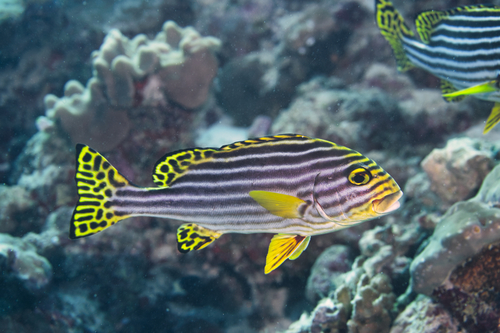
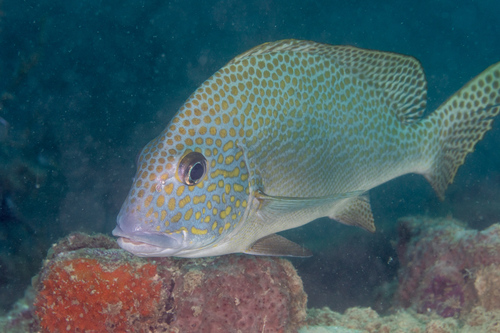
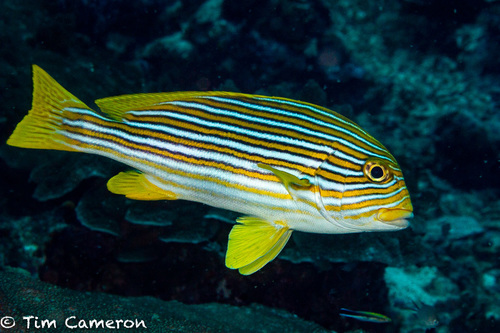
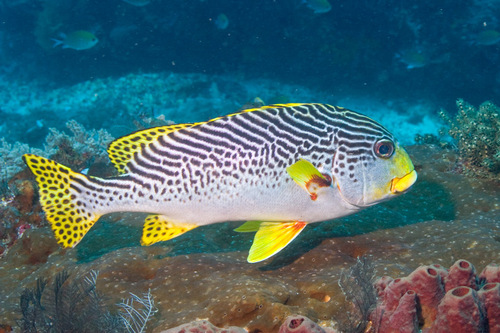
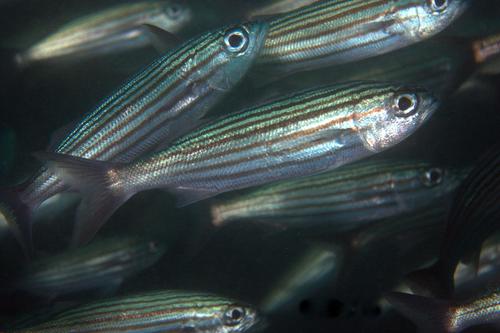
This species was originally described as Brachygenys jessiae, with the currently accepted scientific name Xenocys jessiae Jordan & Bollman, 1890. It has a relatively slender, elongated body, which is noticeably different from most of its related species. Its head is conical, with large eyes and a short diagonal mouth that has a protruding lower jaw. It has very small teeth arranged in bands on the jaws and palate. The dorsal fin is not continuous; the anterior spiny portion is completely separated from the posterior soft-rayed portion. The anterior portion of the dorsal fin contains 10 spines, while the posterior portion has a single spine and 13 to 14 soft rays. The anal fin has 3 small spines and 10 to 11 soft rays. This species reaches a maximum total length of 30 cm, or 12 inches. Its back is dark silvery-grey, and often has yellowish green, yellowish blue, or blue-green tints. Its colour pales to lighter silver on the flanks, and to silvery-white on the underparts. Seven black horizontal stripes run along the flanks. This species is endemic to waters around the Galápagos Islands in the eastern Pacific Ocean. It occurs at depths between 0 and 20 m, or 0 and 66 ft. It forms dense schools in these shallow waters. During the day, the schools stay along rock walls and over rocky slopes. They feed on plankton and small fishes. It is an oviparous species that spawns in distinct pairs.