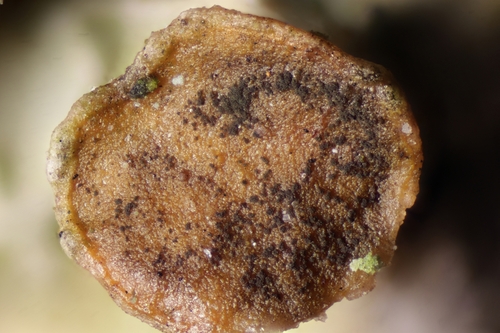
About Xanthoriicola physciae (Kalchbr.) D.Hawksw.
The genus Xanthoriicola is defined by the absence of stromata (compact masses of fungal tissue), setae (bristle-like structures), and hyphopodia (specialized attachment structures). This fungus produces semi-macronematous conidiophores, which are partially differentiated spore-bearing structures. These conidiophores are densely clustered, erect, branched in an irregular brush-like pattern, short, smooth-walled, and brown. Its conidiogenous cells are monophialidic, terminal, determinate, oblong to flask-shaped (ampulliform), brown, and have a short apical collar-like structure. The conidia are globose (spherical) with minutely echinate (spiny) walls, range in color from olivaceous-brown to brown, and are produced singly rather than in chains. Xanthoriicola physciae is the only known species in the genus, and it grows inside the fruiting bodies (ascocarps) of its host lichen. Its mycelium (fungal threads) develops in the thecium, the spore-producing layer of the host's ascocarps, and causes the ascocarps to turn black. The fungus's hyphae are septate, smooth-walled, pale brown, and 3–6 μm in diameter. It produces its spore-bearing structures 12–20 μm below the surface of the epithecium, the upper layer of the ascocarp. The conidiogenous cells are approximately 5 μm wide and 6 μm tall, with a short collar-like structure (collarette) that measures 0.75–1.25 μm tall. The conidia are spherical, 3.5–6 μm in diameter, and have minutely spiny walls. When infected by the fungus, the apothecia (fruiting bodies) of the host lichen turn sooty black and are easy to spot in the field. Whole colonies of the host lichen are rarely affected, which indicates that while the fungus is parasitic, it does not typically destroy host populations. No sexual stage has been found for X. physciae, and no sexual stage has been proposed by association with other fungi that grow on the same host lichen. The fungus has not been successfully grown in isolated culture, and experiments that attempted to inoculate fresh host specimens have also been unsuccessful. These traits made it historically difficult to determine the fungus's taxonomic position before molecular methods became available. Xanthoriicola physciae is a common lichenicolous fungus found throughout Europe, including the British Isles. It grows specifically on the ascocarps (fruiting bodies) of the lichen Xanthoria parietina, a common yellow-orange lichen that often grows on tree bark and rocks. Xanthoriicola physciae has several unusual ecological traits when compared to typical parasitic fungi. Infected, blackened apothecia of its host lichen are usually well-spaced within healthy host populations, with affected apothecia often separated by 18–75 cm from each other, surrounded by unaffected host apothecial discs. Field observations and experiments have shown that the fungus does not spread to adjacent healthy thalli, even after three years of continuous monitoring of labeled specimens. This non-contagious behavior is especially unusual among fungal parasites. The fungus appears to have a remarkably stable and long-lasting relationship with its host. Blackened apothecia can stay apparently unchanged for many years, with some observed on oak branches estimated to be at least 35 years old. Eventually, these infected apothecia become overgrown by green algae. Before this overgrowth occurs, other lichens such as Ramalina species may grow among the infected apothecia. Occasionally, other lichenicolous fungi like the pink Illosporiopsis christiansenii can grow on the blackened apothecia themselves. In some cases, the lichen Physcia tenella has been observed growing on infected apothecia, and many instances have been recorded where infected areas become overgrown by unidentified buff-coloured resupinate basidiomycetes. Infected lichen thalli appear to be more likely to detach from their substrate. Observations of tree trunks show that patches of X. parietina that have fallen out, taking X. physciae with them, are missing from existing populations. These detached fragments can often be found beneath trees after windy conditions, and may act as a dispersal mechanism for both the host lichen and its fungal parasite. Despite producing abundant conidia that measure 3.5–6.0 μm in diameter, laboratory attempts to germinate these spores on various growth media have been unsuccessful, which suggests the conidia experience some form of fungistasis (dormancy). Plastic coverslips suspended in trees near infected lichens have captured large numbers of ungerminated conidia, showing that while the spores are easily dispersed, the specific conditions required for their germination remain unknown.

