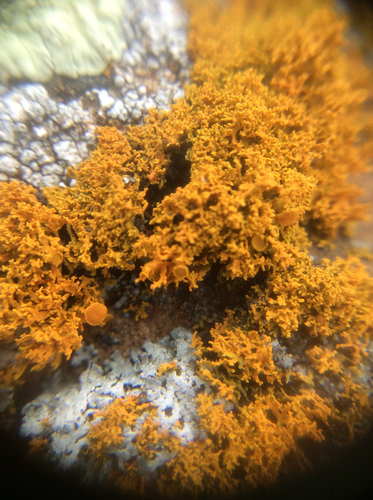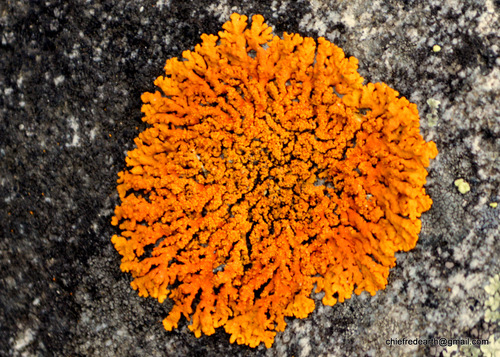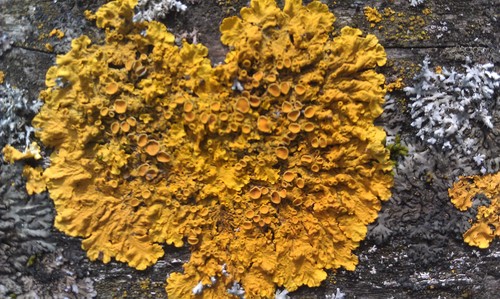
About Xanthoria parietina (L.) Th.Fr.
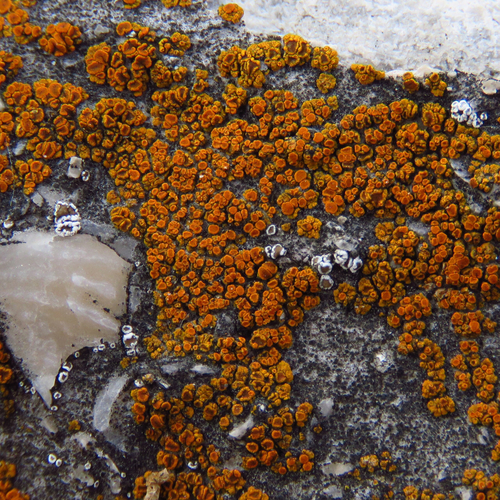
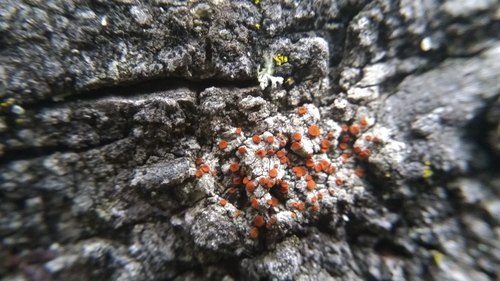
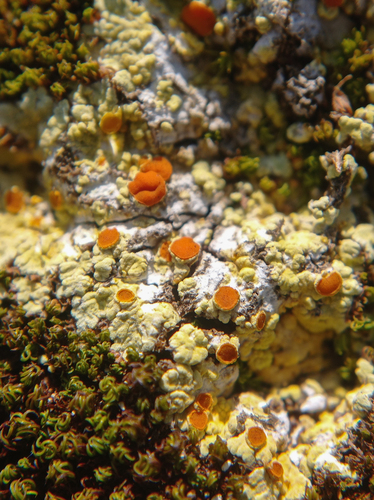
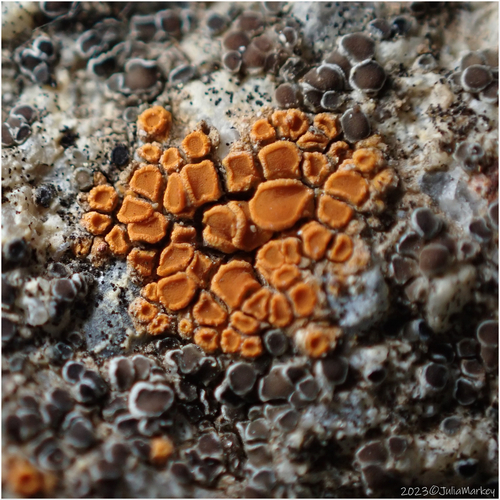
Xanthoria parietina (L.) Th.Fr. is a foliose (leafy) lichen whose vegetative body, the thallus, is typically less than 8 centimeters wide. The thallus has flattened lobes that are usually 1–4 mm in diameter, rarely reaching up to 7 mm; lobes from African populations are smaller, typically 0.5–2.0 mm wide, than those from temperate regions. The upper surface of the thallus ranges from yellow, orange, or greenish yellow, and turns almost green when growing in shaded areas. The lower surface is white, has a cortex, and bears sparse pale rhizines or hapters that anchor the thallus to its substrate. This species does not produce soredia or isidia, the vegetative reproductive structures common in many lichens, and reproduces primarily sexually via fruiting bodies called apothecia. Apothecia usually develop 2–4 mm behind the growing edge of the thallus and take 12–18 months to reach maturity. Mature apothecia are typically 1.5 to 2.6 mm in diameter, and may rarely reach up to 4.3 mm. They can make up 0–87% of a thallus's dry weight, with most thalli allocating 10–30% of their biomass to these structures. Under humid conditions, apothecia can release up to 50 spores per minute. Apothecia production does not depend on the directional aspect the thallus faces, meaning sunlight exposure does not significantly affect reproductive effort. The cortex, the lichen's outer "skin", is made of closely packed fungal hyphae; it protects the thallus from water loss via evaporation and from damage caused by high levels of irradiation. Thallus thickness varies with the habitat the lichen grows in: thalli in shady locations are much thinner than those in full sun, which protects the lichen's algal partner that cannot tolerate high light intensities. Ascospores produced by X. parietina are hyaline (colorless and translucent), ellipsoid, and typically measure 13–16 by 7–9 μm. Like all lichens in the family Teloschistaceae, these spores are polarilocular, meaning they are split into two locules by a central septum with a perforation. The septum measures 3 to 8 μm wide. Xanthoria parietina is a cosmopolitan species recorded from Australia, Africa, Asia, North America, and most of Europe. In eastern North America and Europe, it is found more often near coastal locations. In Southern Ontario, Canada, its reappearance has been linked to increased nitrate deposition from industrial and agricultural activity. The species strongly prefers coastal habitats, where it benefits from the deposition of marine aerosols. In Maine, USA, X. parietina is abundant on gravestones near the ocean, and its numbers drop sharply further inland. It becomes rare beyond 40 km from the coast in southwestern Maine, and beyond 130 km inland in eastern Maine. This inland distribution pattern is largely shaped by the deposition of marine-derived nutrients, especially chloride and sodium, which are carried inland by wind and precipitation. Historically, in North America, the species was mostly limited to coastal regions: along the Atlantic coast from Newfoundland to Pennsylvania, along the Pacific coast from California to the Pacific Northwest, and in a small area of the Gulf coast in Texas. Within the Pacific Northwest, its traditional range was west of the Cascades, from the Willamette Valley to the Puget Sound region. However, since the early 2000s, the species has been recorded in multiple inland cities in Idaho, Washington, and parts of western Montana. These inland occurrences are mostly associated with urban environments, particularly on planted ornamental trees in arboretums and parks, which indicates human-mediated dispersal. These documented range expansions mark X. parietina as one of the few lichen species that has become clearly invasive in new territories, primarily through horticultural introduction pathways. Research shows that X. parietina is transported inland on nursery stock from coastal regions, supported by its presence on commercial nursery plants and absence from naturally occurring woody plants in undisturbed areas outside these cities. Wind direction plays a key role in how far inland X. parietina spreads. Southwesterly winds in warmer months carry marine aerosols further inland, while easterly storms add additional sea salt deposition via precipitation. This influence of aerosols is visible in Maine cemeteries: X. parietina is more common in open cemeteries exposed to prevailing winds, compared to wooded cemeteries that block or trap airborne sea salts and have much lower frequencies of the lichen. In recent decades, inland populations of X. parietina have been found in southern Ontario, showing an expansion beyond its traditional coastal range. Once thought extirpated from the region, the species was rediscovered growing on trees in multiple inland locations. It is unclear whether the lichen has reestablished after a long absence or has persisted undetected for decades. The expansion may be connected to increasing nitrogen deposition from agricultural runoff and air pollution, which creates favorable conditions for nitrophilous lichens like X. parietina. Another possible factor in its inland spread is the widespread use of road salt in Ontario over the past 50–70 years. Since X. parietina grows well in salt-rich coastal environments, roadside salt deposition may have created an artificial habitat that mimics the chemical conditions of coastal regions. The lichen is often found near highways and on trees growing along drainage ditches that receive runoff from fertilized fields, further supporting the role of human-caused nutrient enrichment in its inland establishment. The lichen grows on a range of substrates and in diverse habitats. It occurs in hardwood forests in broad, low-elevation valleys, and is found sporadically on Populus and other hardwoods in riparian zones of agricultural and populated areas. It preferentially colonizes the upper parts of tree trunks (around 70% of total tree height), where the bark is younger and more exposed to sunlight. It is also abundant on farm buildings and on rocks immediately above the high water mark in coastal zones. On rocky seashores, it typically forms a distinct band in the supralittoral zone, between more halophilic species below and terrestrial species above. Nutrient enrichment from bird droppings improves X. parietina's ability to grow on rock. The species is versatile in its substrate choice and has even been recorded overgrowing lead on lead-incised gravestones in England. The species has ecological resilience thanks to its strong regenerative capacity. Unlike many foliose lichens, where growth is strictly limited to thallus margins, X. parietina can start new growth from nearly any damaged portion of its thallus. This ability to recover from physical damage or fragmentation allows it to persist in disturbed habitats where other lichens would fail to reestablish. Additional records note that distinct morphological forms occur in human-created habitats: a granulose form, formerly classified as Xanthoria aureola, has been recorded mostly on roofs in southeastern England. Many lichens disperse via symbiotic vegetative propagules such as soredia, isidia, or blastidia, but X. parietina does not have these structures, so it must reestablish its symbiotic state with each reproductive cycle. Instead, two species of oribatid mites—Trhypochtonius tectorum and Trichoribates trimaculatus—act as dispersal vectors. They consume X. parietina and disperse its viable ascospores and photobiont cells through their faecal pellets, which facilitates both short- and long-distance dispersal. Despite lacking specialized vegetative propagules, X. parietina has complex reproductive strategies that overcome the challenges of sexual reproduction in lichens. When germinating fungal spores spread across a substrate, they first form associations with common non-symbiotic algae such as Pleurococcus, creating an early "proto-lichen" stage. This widespread network increases the chance of encountering the Trebouxioid photobiont required for proper thallus development. Additionally, the fungal partner (mycobiont) can obtain suitable algal partners from the soredia of other lichens, particularly Physcia species that often grow alongside X. parietina and contain compatible photobionts. Once contact is made with compatible Trebouxia cells, the mycobiont forms specialized structures called haustorial complexes that enable efficient nutrient exchange. These intraparietal haustoria penetrate partially into the algal cell wall, but not into the cell membrane itself. They allow short-distance shifting of photobiont cells and create pathways for carbohydrate translocation from the photosynthetic algae to the fungus. Unlike many other lichens, X. parietina can form multiple haustoria per algal cell, with each haustorium developed by either a single hypha or multiple working fungal hyphae, which improves the efficiency of the symbiotic relationship. Xanthoria parietina has a four-stage life cycle with 13 developmental states. After spore germination, growth progresses through protothallus (only fungal hyphae), proterothallus (initial algal association), and juvenile stages, before eventually forming a full foliose thallus. In young thalli, apothecia cover about half of the thallus margin, but in mature thalli they only occupy around 1/16 of the margin. This decrease shows that as the lichen matures, the relative area dedicated to reproductive structures declines compared to the overall size of the thallus. Environmental conditions strongly influence development: thalli in polluted or urban areas often do not complete their life cycle, while those in clean habitats reach full maturity. Reproductive success varies by substrate: thalli on aspen trees produce more apothecia and spores than thalli on other tree species. Additionally, the mycobiont can associate with non-native algae (e.g., Pleurococcus) before establishing its typical symbiosis with Trebouxia or Pseudotrebouxia, enabling it to colonize a wide range of substrates. Xanthoria parietina grows at an average rate of about 2.6 mm per year, though growth varies by habitat. Moist sub-montane environments support faster growth of 6–7 mm per year, while drier coastal regions slow growth. Growth peaks in cold, wet seasons (autumn and winter) and declines in warm, dry conditions such as those found in Mediterranean climates. The slow growth of X. parietina affects its longevity and dispersal. Without active water uptake, high evaporative demand limits metabolism, especially in wind-exposed, low-altitude regions, where desiccation slows thallus expansion and reduces propagule success. In contrast, high humidity supports steady radial growth, allowing long-term persistence, biomass accumulation, and continuous ascospore release. Strong winds both hinder and help X. parietina: while wind exposure dehydrates thalli and slows growth, it also disperses thallus fragments that act as vegetative propagules in the absence of specialized structures, supplementing spore-based dispersal. Xanthoria parietina releases and germinates spores year-round, though germination is faster in summer (4–5 days) and slower in winter. Optimal germination occurs at pH 6, but spores can tolerate a pH range of 3–7. Germination success and mycobiont development are affected by multiple environmental factors. Substrate influences success: germination rates are higher on agar than in water films. In laboratory settings, ascospores of X. parietina germinate best in liquid nutrient media, particularly malt-yeast extract, which provides essential carbohydrates, amino acids, and vitamins. Higher temperatures speed up germination: 23 °C (73 °F) promotes faster colony formation than 19 °C (66 °F). Light exposure is not required for early fungal growth: cultures grown in darkness develop healthier, more extensive mycelial networks. The morphology of the developing mycobiont gives insight into early symbiosis. In vitro, X. parietina forms septate, branched hyphae, which later develop into lobed structures that resemble early lichen thalli. Scanning electron microscopy reveals a dense, interwoven hyphal network that may facilitate interactions with photobionts during natural lichenization. These adaptations support X. parietina's regenerative ability and ability to establish symbiosis across varied environments. Although X. parietina lacks specialized vegetative propagules, it has a regenerative capacity that boosts its ecological success. Older thalli covered in apothecia detach along drought-induced cracks, while younger margins remain attached. When fragments land on suitable substrates, they regenerate new lobes along wound margins, acting as natural propagules. Field studies show a 150% increase in laminal size in just 13 months for regenerating thalli. In a five-year experiment, X. parietina maintained 50% substrate coverage despite losing 90% of its initial thallus area, because regrowth compensated for the losses. Total turnover (growth plus loss) exceeded 170%, highlighting its dynamic life cycle. Regeneration is driven by actively dividing fungal and algal cells within mature thallus areas, allowing new growth from nearly any part of the lichen body, including apothecial disk margins. This adaptation is particularly common in X. parietina and some Teloschistales species, and gives it a significant ecological advantage over lichens that lack both vegetative propagules and high regenerative ability. This fragmentation-based dispersal contributes to the species' resilience and widespread distribution. Xanthoria parietina has a range of physiological and morphological adaptations that help it survive in diverse habitats. Populations in drier, more exposed habitats produce longer-chain surface hydrocarbons (alkanes), while those in more humid, cooler regions synthesize shorter-chain alkanes; this adaptation helps reduce water loss, similar to what is seen in vascular plants. The thallus morphology of X. parietina is plastic: forms growing in moist stream beds tend to be semi-erect and orange-yellow, while those in drier, sun-exposed sites are more compact and darker orange. These differences are caused by environmental conditions rather than genetic differences. The lichen's survival is closely tied to its dependence on atmospheric humidity. Lacking specialized water-absorbing structures such as roots or stomata, X. parietina absorbs ambient moisture to carry out metabolic activity. When humidity drops, the lichen enters dormancy and pauses photosynthesis until moisture returns. This poikilohydric strategy allows it to survive prolonged dry periods, although growth and reproduction are largely restricted to humid conditions. In wetter climates, continuous hydration supports ongoing metabolism and faster thallus expansion. Environmental factors including air temperature, wind, and evaporative demand influence its physiology: higher temperatures speed up water loss, and strong, dry winds intensify desiccation, particularly in low-altitude coastal regions. In contrast, moderate winds with adequate humidity can improve gaseous exchange and temporarily boost photosynthetic efficiency. This balance between moisture availability and air movement is a key determinant of lichen growth rates across different habitats. The thallus of X. parietina goes through distinct ontogenetic stages that reflect its ecological adaptations. In the juvenile and immature phases, the lichen establishes its foliose form and develops a homeomeric structure with a protective upper crust. As it moves to virginal stages, the characteristic rosette shape forms. During the generative period, apothecia develop gradually, shifting from a scattered central distribution in young thalli to a more concentrated arrangement in both central and peripheral regions in middle-aged specimens. These developmental rates vary with environmental conditions, with optimal formation in well-illuminated habitats with moderate nutrient levels. Ecological competition also affects population structure and morphology. In regions where multiple nitrophilous lichen species coexist, X. parietina often forms a codominant relationship during early colonization, but its higher tolerance to pollution and nutrient enrichment may eventually lead to greater dominance in altered habitats. This dynamic is reflected in the varying proportions of ontogenetic stages, with balanced age distributions in less disturbed environments and disproportionate representation in stressed ones. On rocky substrates, the lichen colonizes surfaces via hyphae emerging from its lower cortex rather than through rhizines. It can penetrate mineral fissures, especially in calcareous rocks, and on softer substrates like calcarenite its hyphae may extend 1–2 mm beneath the surface, promoting mineral fragmentation. On harder andesite, the lichen remains mostly on the surface, contributing mainly to mechanical disaggregation rather than chemical weathering. As a nitrophilous species, X. parietina grows well in nutrient-rich environments. Moderate nutrient input stimulates growth, although excessive levels eventually reduce growth rates. As a result, it is often abundant in areas affected by agricultural runoff, bird perches, and atmospheric nitrogen deposition, where nutrient enrichment can alter lichen community structures by reducing acid-sensitive species. Bird guano is rich in the toxic compound urea, which generally excludes most lichens from these habitats; however, X. parietina has one of the highest nitrogen contents recorded, in part because of its high urease activity that converts urea into CO2 and NH4. Xanthoria parietina has a long history of use in traditional medicine across multiple cultures. In Andalucia, Spain, this lichen was called flor de piedra ('stone flower') or rompepiedra ('stone breaker'). Spanish traditional healers used it for several purposes: treating menstrual complaints when prepared as a wine decoction, addressing kidney disorders and toothaches when made into water-based decoctions, and acting as a general analgesic. They also added it to cough syrups alongside various plant ingredients. In European traditional medicine during the early modern era, X. parietina was boiled with milk to treat jaundice, often alongside Polycauliona candelaria. This use follows the Doctrine of signatures, the belief that plants resembling body parts could treat ailments of those parts: the yellow-orange color of the lichen was thought to indicate it would work against the yellowing of skin that occurs with jaundice. In Traditional Chinese Medicine, it is known as shí huáng yī ('stone yellow clothes') and valued for its antibacterial properties. Widespread medicinal use of lichens including X. parietina had been mostly abandoned by 1800, and these applications are historical folk remedies rather than evidence-based treatments.