About Xanthoria aureola (Ach.) Erichsen
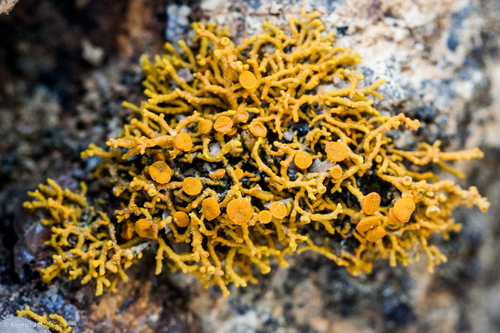
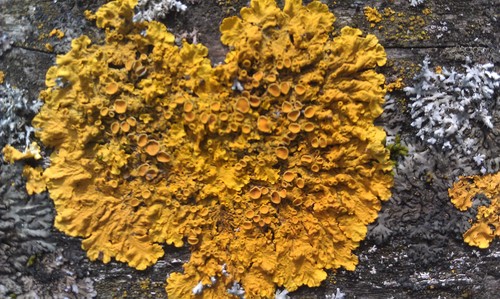
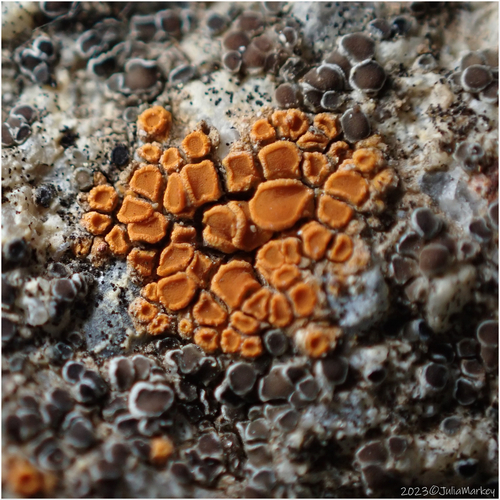
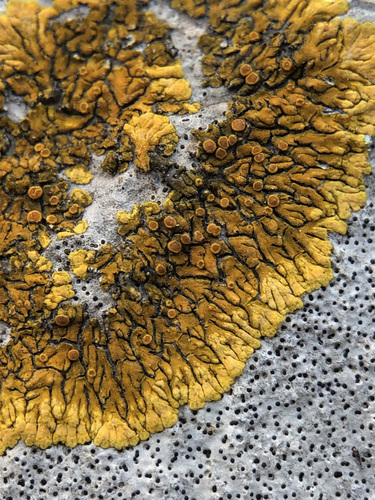
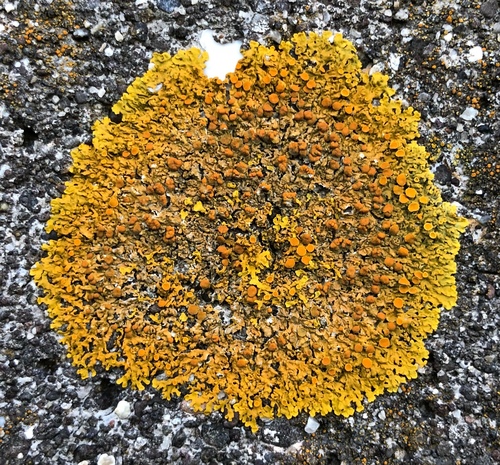
The thallus of Xanthoria aureola has a foliose morphology, and ranges in color from bright yellow to orange or orange-red. It is defined by overlapping, strap-shaped lobes that undergo dichotomous branching. When treated with potassium hydroxide, the thallus turns deep red (a K+ red reaction). The average lobe width ranges from 0.46 to 1.6 mm, and the average lobe thickness is 135 μm. X. aureola has a lower cortex, but lacks true rhizines. Scattered hapters are present on the cream-colored underside of its thick lobes. Its upper cortex is rough, covered with a layer of crystals, and bears only a small number of apothecia. This species contains the chemicals parietin, fallacina, emodin, teloistin, and parietinic acid, along with mutatoxanthin, its dominant carotenoid. Mutatoxanthin, a carotenoid that protects the lichen's photosynthetic component from intense sunlight, makes up 94.4% of X. aureola's total carotenoid content, and X. aureola has higher levels of mutatoxanthin than any other species in the genus Xanthoria.
X. aureola is often mistaken for the closely related species X. parietina and X. calcicola. Compared to these two species, X. aureola has a brighter thallus color and a considerably thicker medulla (187 mm, versus 114–120 mm in the other two species). In addition, the rough upper surface of X. aureola has few apothecia, lacks soredia or isidia, and produces lobules as its laminar structures. Substrate preference also distinguishes the species: X. aureola grows only on seashore rocks, while X. calcicola and X. parietina can grow on nearly any rock or wall.
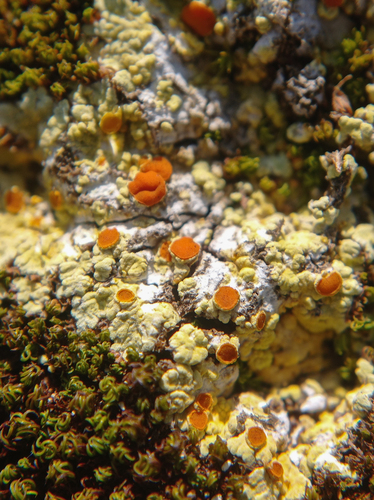
Xanthoria aureola grows on exposed maritime rocks in sunny locations. It most often grows on nutrient-rich siliceous rocks, but can also be found on limestone and lignum. It occurs along European coasts at elevations from 0 to 150 meters above sea level, and is common in Spain, Portugal, France, Ireland, Denmark, Sweden, Norway, Italy, and the UK. It typically grows adjacent to X. parietina, but occurs in greater abundance and is found on more exposed rock.
The photosynthetic algal symbiont that lives with X. aureola is a species of Trebouxia. During photosynthesis, Trebouxia fixes 14C mostly into ribitol: approximately 80% of fixed carbon becomes ribitol, 5% becomes sucrose, 4% becomes organic acids, and 9% becomes baseline CH. This makes ribitol the main form in which carbohydrates are transferred between the two symbionts in the thallus. Carbon flow from Trebouxia to the fungal partner of X. aureola is efficient, with a steady transfer rate completed in 15 minutes. Only around 2% of fixed carbon is stored as insoluble compounds in the thallus. The mean chlorophyll content per algal cell ranges from 3.0 to 4.8 x 10⁻⁶ mg.
Environmental disturbance has a significant impact on the efficiency and productivity of X. aureola. Lichen species are often used to monitor pollution because they are sensitive to sulfur dioxide, heavy metals, salt, and high levels of UV radiation. Environmental stress such as increased UV light boosts the production of reactive oxygen species (ROS), including superoxide and hydrogen peroxide. While higher UV exposure leads to more ROS formation across all tested species, Xanthoria species show the greatest resilience to intense light conditions. Pre-treatment with salicylic acid followed by high-energy radiation results in reduced amounts of certain amino acids, specifically glutamic acid (Glu), tyrosine (Tyr), and proline (Pro), which are required for protein formation and basic biochemical functions. Experiments have also confirmed that X. aureola is sensitive to high concentrations of heavy metals and salt. Membrane integrity was measured via both conductivity and potential photosystem II (PSII) efficiency (Fv/Fm), and conductivity was found to be a more accurate measurement. High levels of UV, salt, and heavy metals all increase membrane breakdown and electrolyte leakage. X. aureola is more resistant to salt than the other lichen species Lobaria pulmonaria and Parmelia sulcata. Copper and zinc had no observed effect on the Fv/Fm of X. aureola. It is thought that zinc and iodine naturally present in seawater protect Trebouxia and increase the lichen's resistance to high salt and UV exposure. Increasing environmental stress tends to worsen both ROS formation and electrolyte leakage.