About Xanthorhiza simplicissima Marshall
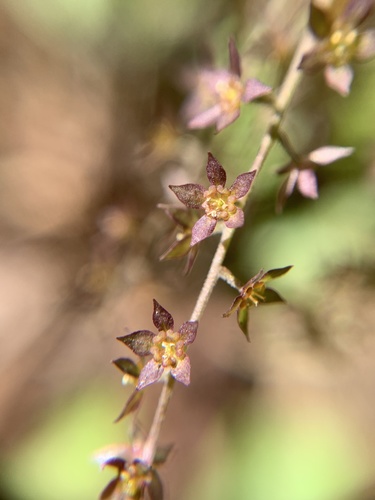
In the wild, Xanthorhiza simplicissima Marshall (yellowroot) grows on stream edges in sandy soil under dappled sunlight. In cultivation, it is often grown with more sunlight to produce more vivid fall colors. It is a subshrub, reaching 20–70 centimetres (8–28 in) in height, and rarely up to 90 centimetres (35 in). Its stems grow up to 6 millimetres (0.24 in) in diameter. Its leaves are arranged spirally, are 10–18 centimetres (4–7 in) long, and each leaf is divided into 5 toothed leaflets. Flowers only grow from the upper portion of the plant's unbranched stem. Flowers are borne in broad panicles 6–20 centimetres (2–8 in) long; each individual flower is small, star-shaped, and reddish brown to purple brown, with five petals. Yellowroot propagates asexually by sending out many underground runners, and reproduces sexually via seeds. It is classified as an endangered species in Florida. Yellowroot is comparatively rare in British gardens, though distinguished plantsmen E.H. Wilson and E.A. Bowles have promoted its cultivation. Bowles grew it in his garden at Myddelton House, near Enfield, Middlesex. Current gardens that cultivate yellowroot include Savill Garden at Windsor, Berkshire and Westonbirt Arboretum near Tetbury, Gloucestershire. Wilson, who considered yellowroot one of the best plants for hardy deciduous ground cover, described its use at the Arnold Arboretum at Harvard University in Massachusetts in 1923. It is hardy in USDA winter hardiness zones 3 to 9. Native American cultures used tea made from its root to treat stomach ulcers, colds, jaundice, sore mouth, and sore throat, and used it as an astringent. It has also been used as a folk remedy for diabetes and hypertension in the southern United States. This species contains berberine, a compound with anti-inflammatory, astringent, hemostatic, antimicrobial, anticonvulsant, and immunostimulant properties. Berberine also stimulates secretion of bile and bilirubin, and may be useful for correcting high tyramine levels in people with liver cirrhosis.