About Xanthocryptus novozealandicus (Dalla Torre, 1901)
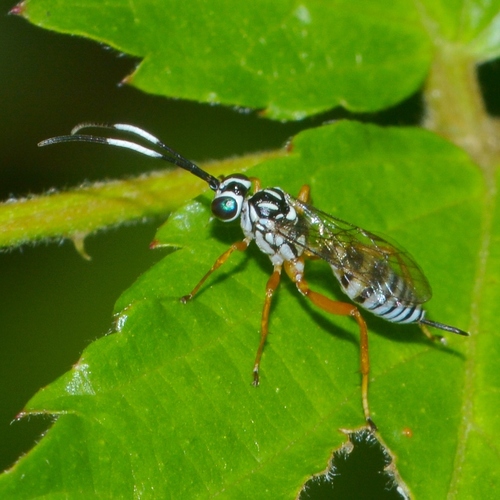
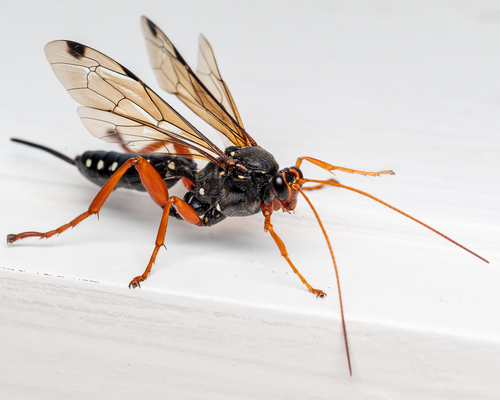
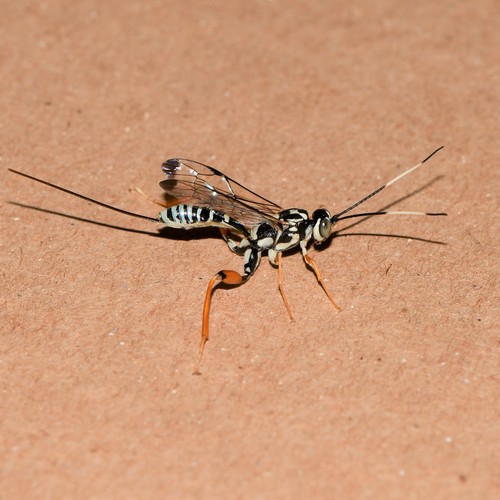
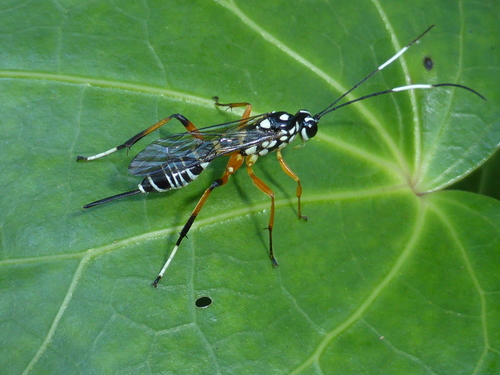
This species is scientifically named Xanthocryptus novozealandicus (Dalla Torre, 1901). Females of the species are larger than males. Females reach 9 to 15 mm in length, while males measure 5 to 11 mm. Their bodies are primarily black, with white spots covering the thorax, and white stripes along the abdomen and head. Their front legs are typically short, and their four hind legs are much longer. The hind four legs are mostly reddish-brown with black tips, and the two rearmost legs each have one white band. They have very long black antennae that feature a single distinct white band near the tip, though the tip itself remains black. The wasp uses the white section of its antenna to palpate damaged wood and locate a suitable host. X. novozealandicus attacks the beetle Drototelus elegans, which mimics the wasp's coloration. This is thought to be an example of aposematism that protects the beetle from birds. The beetle mimics its parasitoid in both coloration and flight pattern. Xanthocryptus novozealandicus is native to New Zealand, New Guinea, and Australia. Within New Zealand, it can be found across the North and South Islands, as well as the Three Kings Islands. On the North Island, populations occur in Northland, Auckland, the Bay of Plenty, Manawatū-Whanganui, Waikato, Hawke's Bay, and Wellington. On the South Island, it has been recorded in Tasman, Nelson, the West Coast, and parts of Canterbury and Otago. In New Zealand, this wasp has been found in natural forests and small clearings. There has not been much specific research into X. novozealandicus's preferred habitat, but members of the Ichneumonidae family, which it belongs to, can be found in most terrestrial environments where their host species is present. The life cycle of X. novozealandicus has four distinct stages: egg, larva, pupa/cocoon, and adult. It is currently unknown how long the wasp takes to fully develop. This wasp, also called the Lemon Tree Borer Parasite, uses beetle larva bodies to host its offspring. In March, female X. novozealandicus search for hosts to lay their eggs. They can visually identify tree bark damage caused by wood boring beetles. The species gets its common name from its most well-known host, the Lemon Tree Borer. Researchers hypothesize the wasp's long antennae allow it to sense beetle larvae through tree bark, even when larvae are deep inside wood. Females use a specialized tube-like spike called an ovipositor to penetrate the bodies of host beetle larvae. This ovipositor is sharp enough to penetrate both the grub's body and the tree's wood. After insertion, the parasitic wasp quickly deposits its eggs inside the host. As X. novozealandicus larvae develop, they feed selectively in order to avoid killing their host.