About Xantho hydrophilus (Herbst, 1790)
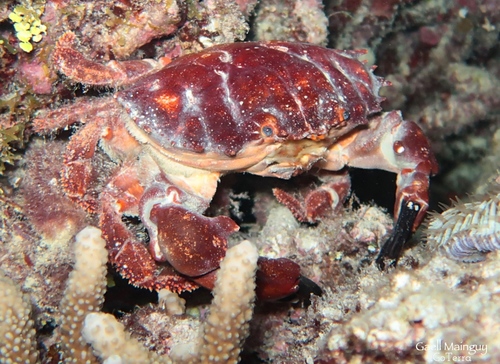
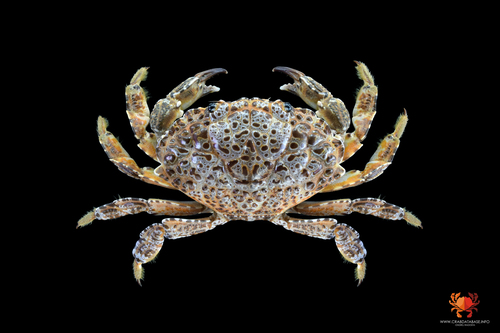
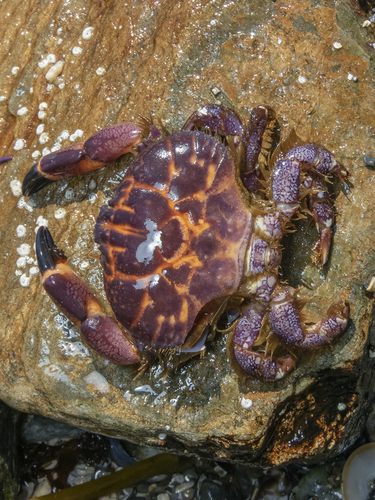
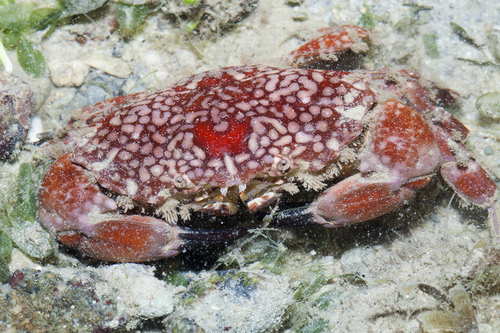
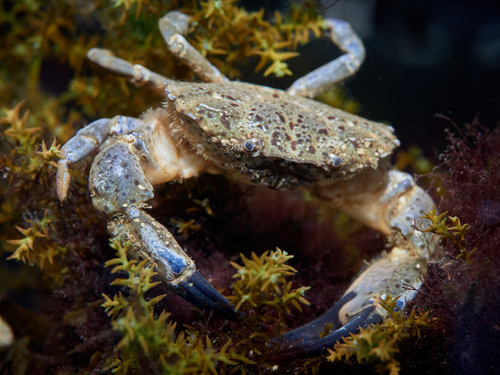
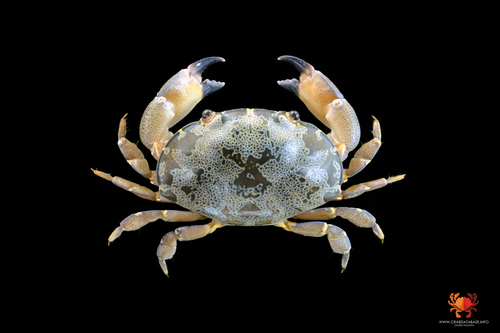
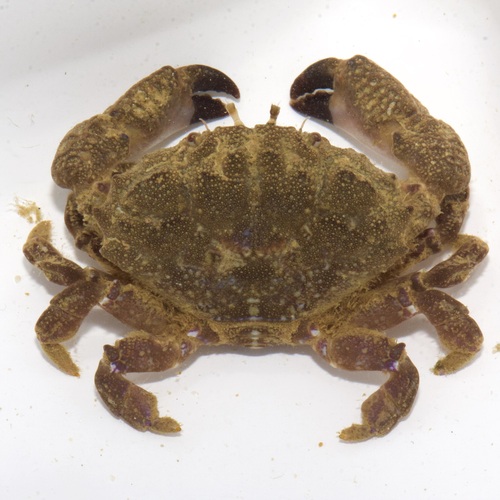
Xantho hydrophilus (Herbst, 1790) has a carapace that reaches 70 millimetres (2.8 in) wide, and grows up to 22 mm (0.9 in) long. To the unaided eye, the dorsal surface of the carapace looks smooth, but fine granules are visible on closer examination. The antero-lateral edge of the carapace has five blunt lobes. Its chelipeds are large, robust, equal in size, and do not have spines or tubercles. Its pereiopods, or walking legs, are relatively short and quite stout. This species is yellowish-brown overall, except for the black tips of its chelae. X. hydrophilus is very similar in appearance to Xantho pilipes, and can be told apart by the lack of setae fringes on its second to fifth pairs of walking legs. Additional key identification features are: the second to fourth pairs of antero-lateral lobes are separated by a wide, shallow inward-pointing depression; the postero-lateral margins of the carapace are bristly; and the inner surface of the propodus has a broad, longitudinal pitted cavity. Xantho hydrophilus is distributed from the Mediterranean Sea, Cape Verde Islands, Azores and Canary Islands in the south, north to the western and southern coasts of the British Isles, with its northern limit reaching western Scotland. Xantho hydrophilus lives under stones on sandy and stony beaches below the intertidal zone, at depths up to 40 metres (130 ft), though it can occur in rock pools during low tide. It is an omnivore that feeds mainly on a variety of algae, and also scavenges for food. It is most active at night. When disturbed, it spreads its large chelipeds to appear larger. Mating occurs in spring; females carry fertilised eggs on their pleopods from March to July, and larvae can be found in plankton through most of the summer.