About Xalocoa ocellata (Fr.) Kraichak, Lücking & Lumbsch
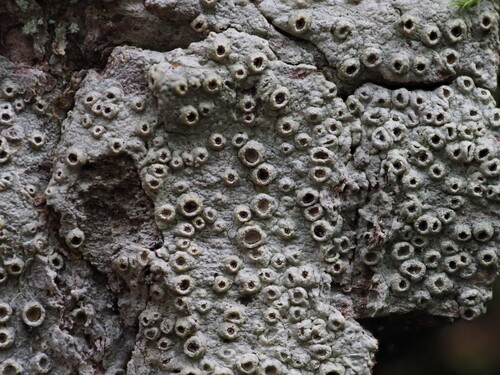
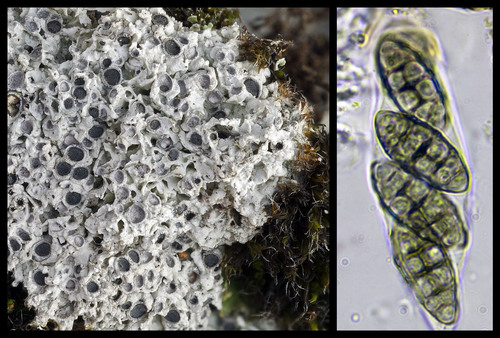
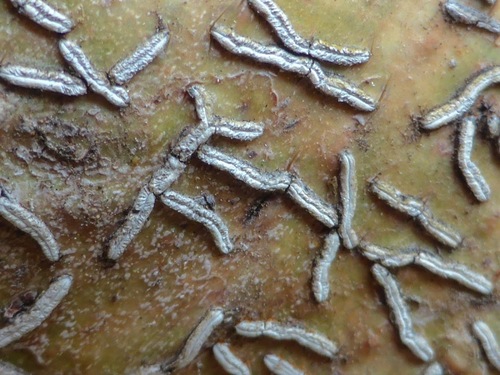
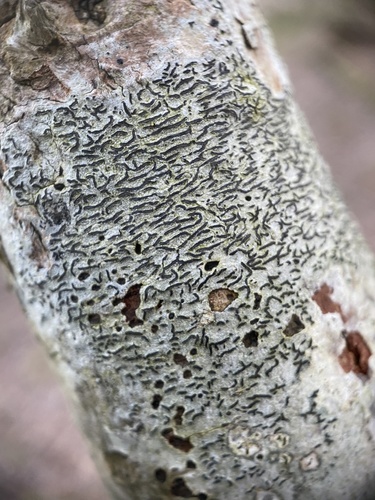
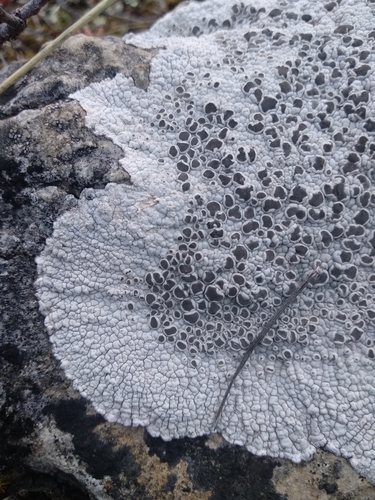
Xalocoa ocellata (Fr.) Kraichak, Lücking & Lumbsch forms a thin, grey-white crust called a thallus, which is covered by an epinecral layer. This layer is a delicate, often slightly powdery film made of dead fungal cells that helps the organism's surface shed water. Its reproductive structures, known as apothecia, are unusually large for members of its family, growing up to about 4 mm across. Each apothecium is lecanorine: a round, exposed disc sits within a thick rim of tissue derived from the thallus, called the thalline margin. This gives the fruiting bodies the appearance of tiny greyish eye-spots set into the crust. Underneath this margin is a very thin, uncarbonised proper exciple, the cup-shaped tissue that lines the disc. The spore-bearing layer, called the hymenium, is clear and not filled with oil droplets, a trait described as non-inspersed. Microscopically, the asci produce eight pale-brown, multi-chambered muriform ascospores that have no starch reaction, meaning they are non-amyloid. The spores measure roughly 25–45 μm long and 10–15 μm wide, and are divided by both transverse and longitudinal partitions called septa, which gives them a brick-like appearance. Asexual reproduction occurs through slender, rod-shaped bacilliform conidia. Chemical spot tests detect norstictic acid, a secondary metabolite that often produces a yellow to red reaction in the medulla when tested with potassium hydroxide solution, known as the K test. The combination of large lecanorine apothecia, absence of lateral paraphyses, muriform spores, and norstictic acid chemistry distinguishes Xalocoa from superficially similar genera in the family Graphidaceae. Xalocoa ocellata has a nearly cosmopolitan distribution, and occurs in regions with a Mediterranean climate. It has been recorded from Yunnan and Sichuan provinces in China.